
Hair Transplant FUE vs FUT (2026): The Honest Comparison
📌 TL;DR
- FUE extracts follicles one by one (scattered dot scars, wear hair short, costs more). FUT removes a strip (one linear scar, more grafts per session, cheaper per graft). Both move existing hair — neither creates new follicles.
- Graft survival is comparable between modern FUE and FUT when done by a skilled surgeon. Technique matters far less than operator skill and donor management.
- A transplant does NOT stop androgenetic alopecia. Transplanted hair is DHT-resistant, but your native hair keeps thinning. You must stay on finasteride and/or minoxidil afterward or the result unravels.
- US cost runs $4,000–15,000+; Turkey clinics advertise $1,500–3,000. Cheap megasession mills carry real risks — overharvested donor areas and poor graft survival don't show up until it's too late to fix.
- Wrong candidates: men under ~25 with unstabilized loss, anyone with diffuse unpatterned alopecia (DUPA), and people expecting teenage density. Get loss stabilized on drugs first.
Hair Transplant FUE vs FUT (2026): The Honest Comparison
Last updated: May 2026 | Written by RK
A hair transplant is the only treatment that physically rebuilds visible density rather than slowing loss. It’s also the most expensive, the most permanent, the most operator-dependent, and the one most often sold with promises it can’t keep. Before the FUE-vs-FUT question even matters, one fact has to land: a transplant does not stop hair loss. It relocates follicles. The hair loss process keeps going around them.
This is the deep-dive the main treatments guide pointed toward. It covers the two surgical techniques honestly, the cost reality including medical tourism, and — most importantly — who should not get one.

The two techniques, plainly
Every modern hair transplant moves follicular units — natural groupings of 1–4 hairs — from a permanent donor zone (back and sides of the scalp, genetically resistant to DHT) into thinning recipient areas. The two techniques differ only in how the follicles leave the donor zone.
The recipient-site work — making the incisions and placing the grafts — is essentially identical between the two. The harvest is the entire difference, and everything else (scarring, cost, recovery, capacity) flows from it.
FUE has become the more commonly requested choice in many clinics, driven by patient demand for smaller, less visible donor scars [1]. That’s partly genuine advantage and partly marketing — “scarless” sells, even though FUE is not actually scarless.
Head-to-head comparison
Does one technique grow better hair?
This is the question clinics market hardest on, and the honest answer is anticlimactic.
Observational comparisons — no large RCTsHistorically, FUT was argued to have a small graft-survival edge because strip dissection under a microscope produced less follicle damage (transection) than blind punch extraction. Modern FUE — with better punches, experienced operators, and improved technique — has largely closed that gap. There is no head-to-head trial directly comparing graft survival between the two techniques [2][3]; the technique overviews describing modern FUE and FUT methods support the more modest claim that, in the hands of a skilled surgeon, clinicians generally consider outcomes between the two techniques to be similar — but this is clinical consensus, not comparative data.
The variable that actually predicts your result is not FUE vs FUT. It’s:
Surgeon and team skill
Graft handling, time out of body, hairline design, incision angle and density. A great FUT beats a mediocre FUE and vice versa. The technique label tells you almost nothing about the operator.
Donor management
Harvesting conservatively so the donor zone still looks natural — and so grafts remain available for a future session as loss progresses.
Whether your loss is stabilized first
A flawless transplant into an actively-shedding scalp still looks bad in three years. Drugs first, surgery second.
The scar question — usually the real decider
For most people choosing between the techniques, scarring is the deciding factor, because the cost and survival differences are modest.
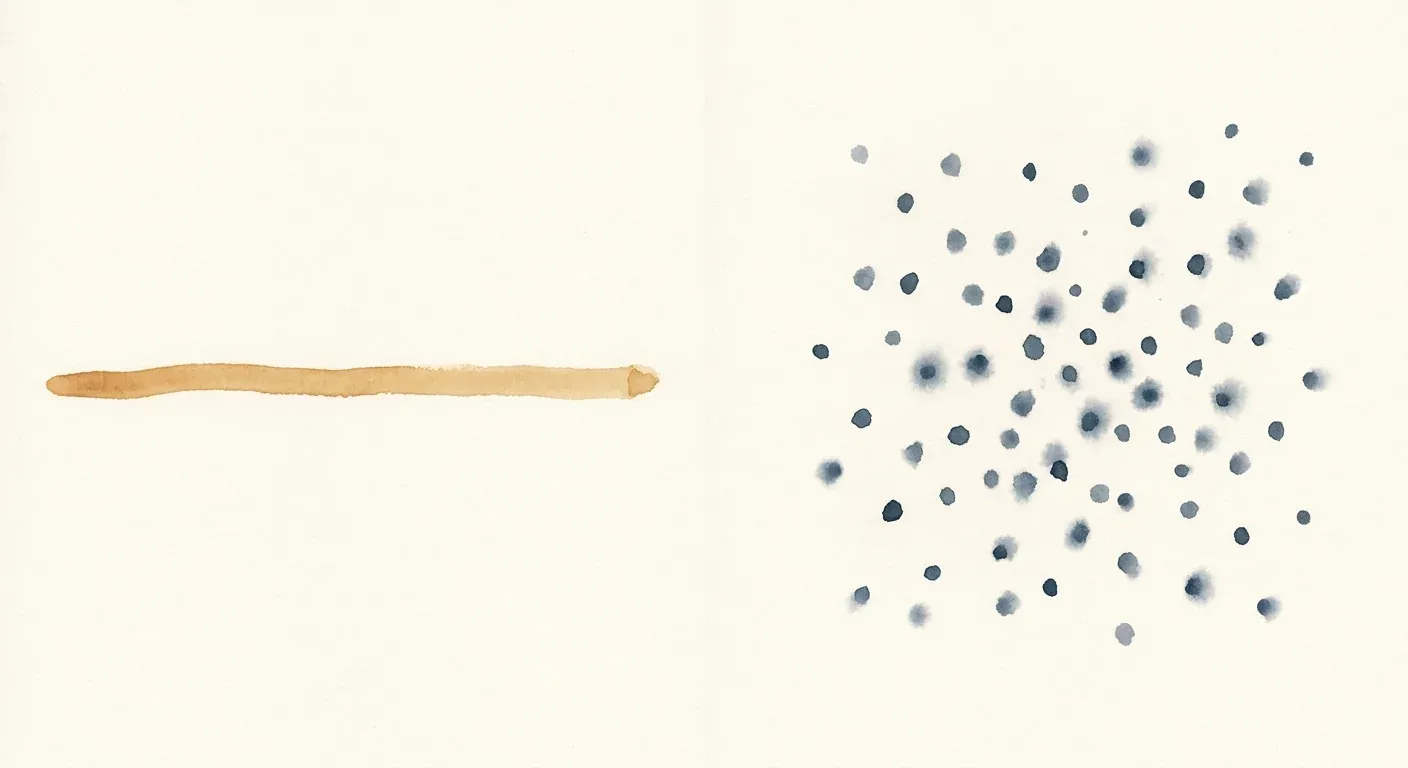
FUT leaves one line; FUE leaves a field of dots. Both are permanent. The question is which one your future haircut can hide.
FUT’s linear scar is a single thin line across the back of the head. A good surgeon keeps it fine, but it is permanent and becomes visible if you ever clip your hair shorter than roughly a #3 guard (about 10 mm). If you plan to keep medium-length hair indefinitely, it’s a non-issue.
FUE’s dot scars are hundreds of ~1 mm circular marks. Individually nearly invisible, but they’re real — and if the donor area is overharvested, the cumulative effect is a moth-eaten, low-density look at very short lengths. “Scarless” is marketing. “Less conspicuous scarring at short hair lengths” is accurate.
The honest framing: choose FUE if you want the option of buzzing your hair short. Choose FUT if you’ll keep it longer and want maximum grafts for the money.
Cost reality, including medical tourism
The medical-tourism savings are real, and good surgeons absolutely exist abroad. The danger is structural: a transplant is permanent, and a bad one is very hard to fully repair. Overharvested donor zones and depleted graft reserves cannot be undone. The hidden costs of a cheap procedure — a corrective surgery, or simply living with the result — can dwarf the upfront saving.
Non-negotiables regardless of location: verify the surgeon personally performs incisions and oversees the case (not a rotating technician crew), see unedited before/after photos at 12+ months, and confirm a donor-area assessment was done before they quoted you a graft count.
The caveat that matters more than the technique
A transplant relocates DHT-resistant follicles. It does nothing to the androgenetic alopecia process driving your loss.
⚠️ A transplant is not a cure — it’s a renovation on a house that’s still settling
Transplanted hair is permanent. Your native, non-transplanted hair keeps miniaturizing if AGA isn’t treated. Get a transplant without staying on finasteride and/or minoxidil, and within a few years you can have transplanted islands surrounded by continued thinning — a patchier look than you started with. The drugs are not optional add-ons. They are what protects the investment.
This is why every responsible surgeon insists on stabilizing loss with medication first. See the DHT blockers comparison and the minoxidil guide for the medical side that has to be in place before — and continue after — surgery.
Who should NOT get a transplant
Young men with unstabilized loss (often under ~25)
Your pattern hasn’t fully declared itself. Transplanting a hairline that keeps receding behind it produces a floating tuft and wastes finite donor supply.
Anyone with diffuse unpatterned alopecia (DUPA)
If the donor zone itself is thinning, transplanted hair will thin too. A proper donor-area trichoscopy screens for this. A clinic that skips it is a clinic to leave.
Insufficient donor density
Norwood 6–7 with a thin donor zone may simply not have enough grafts to cover the bald area at a natural density. Honest surgeons say so; mills sell you the session anyway.
Unrealistic expectations
A transplant restores framing and coverage, not the density of a teenager. If you’re expecting that, the result will disappoint regardless of how well it’s done.
A note on the marketing variants
You’ll see branded technique names. Most are variations on the FUE harvest or the placement step, not separate categories:
- Robotic FUE (ARTAS) — a robotic arm assists punch extraction. Can improve consistency; outcome still depends on the human team.
- DHI (Direct Hair Implantation) — grafts are placed with a pen-like implanter rather than pre-made incisions. A placement-step variation, not a different harvest.
- Sapphire FUE — uses sapphire-tipped blades for recipient incisions. Marginal refinement, marketed heavily.
None of these change the core FUE-vs-FUT trade-offs. Don’t pick a clinic for the brand name of its tool; pick it for the surgeon’s track record.
The decision
- • Pattern still progressing — surgery is premature
- • Protects finite donor supply
- • Re-evaluate once loss is stable for 12+ months
- • Dot scars hide better at short lengths
- • Faster donor-area recovery
- • Choose a surgeon who harvests conservatively
- • Lower cost per graft
- • High yield in a single session
- • Scar stays hidden at ≥ 2–3 cm hair length
The meta-point: the FUE-vs-FUT decision is real but secondary. The first decision is whether you’re a candidate at all, and the most important commitment is staying on the medication that protects the result. Get those two right and either technique, in skilled hands, can look excellent.
What to read next
- Hair Loss Treatments — The 2026 Overview — the pillar guide; where transplant fits among all options by Norwood stage.
- Finasteride vs Dutasteride (2026) — the DHT-blocker decision you need settled before and after surgery.
- Minoxidil Complete Guide (2026) — the other half of the medication base that protects a transplant.
- DHT and Hair Loss Explained (2026) — why donor-zone hair is permanent and recipient-zone hair isn’t.
References
[2] Dua A, Dua K. “Follicular unit extraction hair transplant.” J Cutan Aesthet Surg. 2010;3(2):76-81.
Disclaimer: This article summarizes published evidence and surgical practice and is not medical advice. A hair transplant is permanent surgery — consult a board-certified hair restoration surgeon (ideally ISHRS-affiliated), insist on a donor-area assessment, and review unedited 12-month before/after photos before committing. Do not select a clinic on price alone; an overharvested donor zone cannot be undone.