Best Hair Loss Treatments in 2026: A Decision-First Overview
📌 TL;DR
- Five treatments have real RCT support: topical minoxidil, oral minoxidil, finasteride, dutasteride, microneedling, and saw palmetto. Everything else is noise.
- The most-studied stack is finasteride + minoxidil + microneedling — produces the largest effect size in head-to-head trials.
- Norwood 1–2 (early): minoxidil or saw palmetto solo can hold the line for years. No need to start finasteride yet.
- Norwood 3+ progressing: a DHT blocker (finasteride or saw palmetto) is the leverage variable. Topicals alone usually plateau.
- Norwood 6–7 / scarring alopecia: drugs preserve what remains; transplant is the realistic path for visible regrowth.
Best Hair Loss Treatments in 2026: A Decision-First Overview
Last updated: May 2026 | Written by RK
Most “best hair loss treatments” articles waste your time. They list 12 things, hedge on every one, and end with “consult a dermatologist.” Here’s the version that actually decides.
In 2026, there are five categories of evidence-based treatment for androgenetic alopecia (AGA). Everything else — sea moss, hairline lasers under $1000, “scalp detox” kits, biotin gummies — is either weak evidence or no evidence. This article tells you what works, ranks them by effect size, and shows you which combination matches your situation.
If you only have 2 minutes, the takeaways at the top of this article are the answer. If you have 10 minutes, the rest of this page maps out the decision.
At a glance: which treatments actually move the needle
The chart below indexes each treatment’s typical population-level effect on hair density at 6–12 months, scaled relative to the strongest single intervention (oral dutasteride). It’s not a head-to-head trial result — it’s a calibrated estimate based on the reference RCTs cited at the bottom of this article. Use it to scan the landscape, not as exact prescribing data.
The five treatments that actually work
These are the only AGA treatments with multiple peer-reviewed RCTs supporting them. Sorted by effect size (largest first) and accessibility (most accessible first).
A note on what’s NOT on this list, despite heavy marketing:
❌ Biotin — only helps if you’re deficient (rare). Megadosing won’t grow more hair on a non-deficient scalp.
❌ Collagen / sea moss / chebe powder — no AGA-specific evidence. Skip.
❌ “Scalp detox” or peptide shampoos — marketing categories, not evidence categories.
⚠️ Low-level laser therapy (LLLT) — modest evidence. The expensive caps and combs are largely overhyped vs the trial-grade devices. If you’re already maxed on the proven stack, LLLT is a 7th-tier add-on.
⚠️ Ketoconazole shampoo (Nizoral) — small but real DHT-blocking effect at the scalp. Fine to add ($10/month) but won’t move the needle on its own.
How to pick: the decision tree
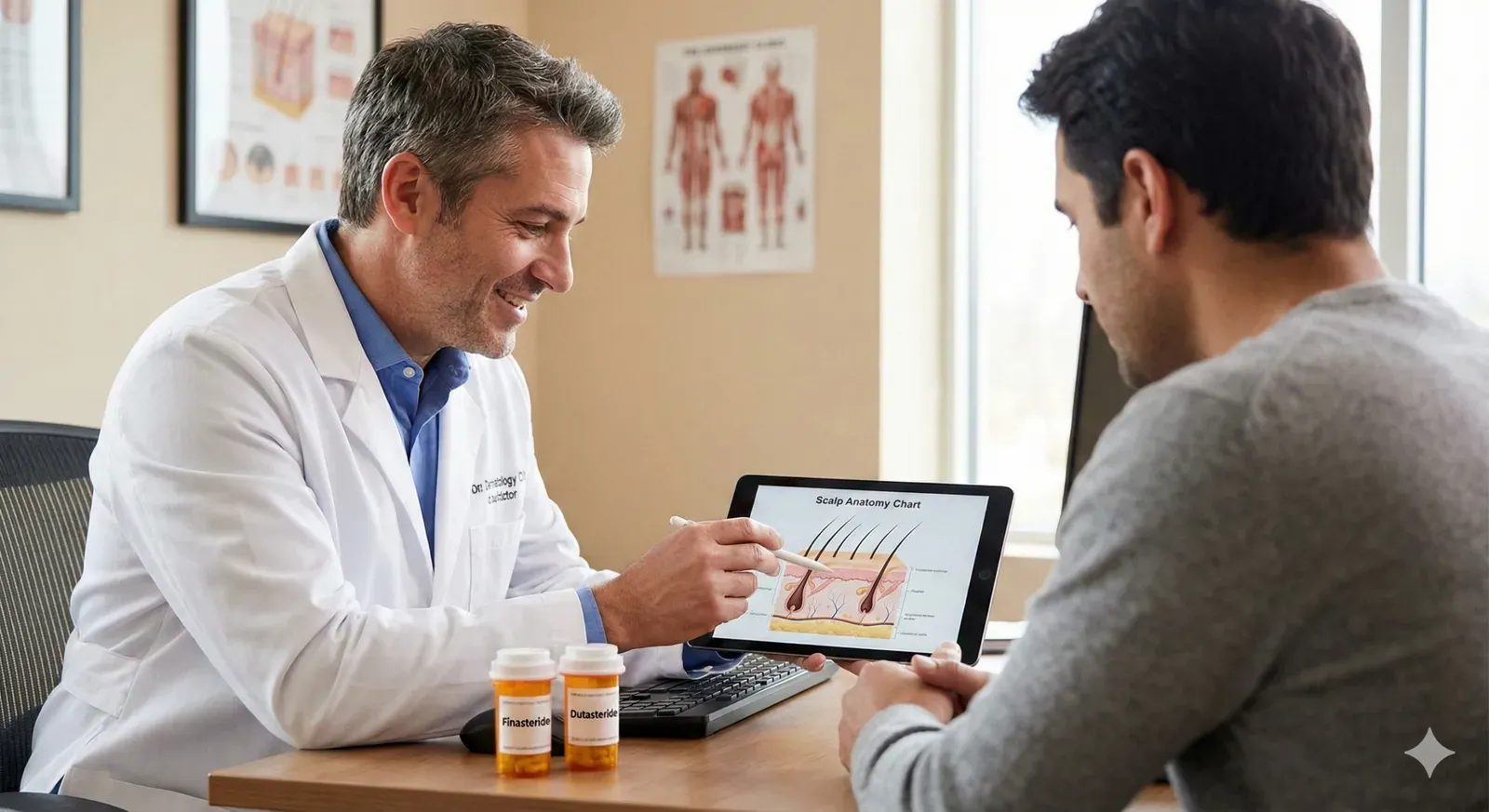
Most people overthink this. Three variables determine your starting protocol:
- How advanced is your loss? (Norwood scale)
- How fast is it progressing? (slow vs visible loss in under 12 months)
- What’s your tolerance for prescription drugs and side effects?
Map yourself to one of the cases below — quick reference grid first, then full detail.
- • $5–15/month
- • No prescription needed
- • Hold the line, reassess at 6 months
- • Most-studied stack
- • Finasteride or saw palmetto for the DHT axis
- • ~$30–60/month
- • 30–50% are biological non-responders
- • Bypasses sulfotransferase bottleneck
- • Telehealth-prescribed
- • Drugs preserve, transplant rebuilds
- • Stabilise loss before surgery
- • FUE technique preferred
- • Topical minoxidil 2% or off-label 5%
- • Spironolactone instead of finasteride (premenopausal)
- • Saw palmetto OK except pregnancy
- • Probably not AGA
- • Could be telogen effluvium / alopecia areata / scarring
- • Don't self-treat the wrong condition
Case 1: Early loss, slow progression (Norwood 1–2)
Norwood 1–2 = slight temple recession or thinning at the crown, not noticeable to most people.
Default protocol:
- 5% topical minoxidil twice daily (foam preferred for sensitive scalps)
- That’s it. Don’t escalate yet.
Why minimal: At Norwood 1–2 with slow progression, the goal is holding the line, not regrowing what isn’t lost. Minoxidil alone can hold this position for many years.
Cost: $5–15/month for Kirkland generic. See Rogaine vs Kirkland Minoxidil (2026) for brand selection.
Reassess at month 6: photo same angle, same lighting. If stable or improved → keep going. If still progressing → move to Case 2.
Case 2: Moderate loss, active progression (Norwood 3+)
Norwood 3+ = visible recession past the temples and noticeable thinning at the vertex. Active progression = noticeable loss in the past 12 months.
Default protocol (most-studied stack):
- 5% topical minoxidil twice daily
- Finasteride 1 mg/day (or saw palmetto 320 mg/day if avoiding Rx)
- 1.5 mm microneedling every 2–4 weeks
Why this stack: Minoxidil and finasteride hit different mechanisms (vasodilation/telogen vs DHT). Microneedling multiplies the topical’s absorption by 2–4×. Together the effect size dwarfs any single intervention.
Cost: ~$30–60/month combined.
If finasteride scares you: Replace it with saw palmetto at 320 mg/day standardized extract. Effect size is roughly 50–60% of finasteride but with side-effect rates matching placebo. See Saw Palmetto for Hair Loss (2026).
Reassess at month 6: real photo comparison. Most users see clear improvement by then.
Case 3: Topical non-responder
You’ve been on 5% topical minoxidil + microneedling for 6 months and seen nothing. About 30–50% of users are biological non-responders due to low scalp sulfotransferase activity.
Default protocol:
- Switch to oral minoxidil (LDOM) at 1.25–2.5 mg/day. Telehealth services like Hims, Roman, Keeps, and Happy Head all prescribe it after consultation.
- Keep the DHT blocker (finasteride or saw palmetto)
- Microneedling becomes optional — oral bypasses the absorption issue
Why oral: The 2025 Sobral et al. meta-analysis found oral and topical produce equivalent density gains, but oral works on more patients because it bypasses the sulfotransferase bottleneck.
Cost: $10–30/month + telehealth consultation fee.
Case 4: Advanced loss (Norwood 5–6)
Norwood 5–6 = approaching full baldness, with thinning bridges between the front and back hair zones.
Default protocol:
- Maximum medical therapy: oral minoxidil + finasteride/dutasteride + weekly microneedling
- Plus consultation for hair transplant (FUE technique). Drugs preserve what’s left; transplant rebuilds visible density.
Why both: At Norwood 5–6, the rate of new loss matters more than the absolute level. Drugs slow that rate. Transplant doesn’t slow loss, so doing it without drugs leads to disappointment as untreated areas continue to thin around the transplanted hair.
Cost: $4,000–15,000 one-time for transplant + ongoing $30–60/month for drugs.

Case 5: You’re a woman
The protocol is similar but with key adjustments:
- Topical minoxidil: 2% is FDA-approved; 5% is increasingly used off-label by dermatologists with comparable safety
- Finasteride / dutasteride: only for postmenopausal women, never during reproductive years (causes severe fetal birth defects)
- Spironolactone: 50–200 mg/day, the female equivalent of finasteride. Anti-androgen at the receptor level, with much better safety than finasteride for premenopausal women
- Saw palmetto: works for women too, especially PCOS-driven loss. Avoid during pregnancy/breastfeeding.
A dedicated women’s pillar guide is on the way.
Case 6: Your loss is sudden / patchy / not pattern-typical
This is probably not androgenetic alopecia. Possibilities:
- Telogen effluvium (acute shedding from stress, illness, postpartum, crash diet, thyroid issue) — treats itself once trigger resolves; minoxidil doesn’t help
- Alopecia areata (autoimmune patchy loss) — needs corticosteroids or JAK inhibitors, not AGA drugs
- Scarring alopecia (lichen planopilaris, frontal fibrosing alopecia) — irreversible loss; needs immediate dermatology evaluation
- Traction alopecia (tight hairstyles) — fixes with hairstyle change
See a dermatologist before starting AGA treatment. Treating the wrong condition wastes 6 months you don’t have if it’s actually scarring alopecia.
What “best” means at each price point
If budget is a real constraint, here’s the practical layering:
~$10/month — Bare bones
Kirkland 5% liquid minoxidil ($5–7/mo) + a $20 dermaroller used every 2 weeks ($1/mo amortized) = real treatment for the cost of a streaming service.
~$40/month — The proven stack
Kirkland 5% foam ($10) + finasteride 1mg generic via Hims ($20) + microneedling kit ($1 amortized) + Nizoral 2× weekly ($5). This is the protocol most dermatologists actually recommend for moderate AGA.
~$80/month — Maximum medical therapy
Switch to oral minoxidil (LDOM) + dutasteride + microneedling. For non-responders to topical or aggressive AGA cases. Requires telehealth consultation.
What about hair transplant?
Hair transplant is a separate decision from drugs and works on different physics: it moves your existing follicles around the scalp, it doesn’t create new ones.
The right time to consider transplant:
- You’ve stabilized active loss with drugs (3–6 months minimum)
- You’re at Norwood 4+ with a clearly defined balding zone
- You have enough donor density at the back/sides
- You can commit to keeping the drugs going post-transplant (otherwise the surrounding hair keeps thinning)
The wrong time:
- You’re still actively losing hair fast
- You’re at Norwood 2 and the loss isn’t bothering people who matter to you
- You’ve been quoted under $4,000 (cheap transplants are usually bad transplants)
For the full surgical breakdown — FUE vs FUT, cost reality including medical tourism, and who shouldn’t get one — see Hair Transplant FUE vs FUT (2026): The Honest Comparison.
Independent evidence verdicts
The verdicts below come from a third-party evidence database that aggregates regulator positions, professional-society guidance, and meta-analyses for each intervention. Use them as an independent reference alongside the article’s own analysis.
Minoxidil for Androgenetic Alopecia
CLM-COND-androgenetic-alopecia-INT-minoxidil-001
≥3 high-quality meta-analyses agree; multi-country first-line recommendation.
- Professional Society — stance: supportive
"Topical Minoxidil 2-5% solution 1 mL or half a cap of 5% foam twice daily is recommended to improve or to prevent progression of AGA in male patients above 18 years with mild to moderate AGA (Hamilton-Norwood IIv-V). [Strength of recommenda…"
Source → - U.S. FDA — stance: supportive
"to regrow hair on the top of the scalp (vertex only, see pictures on side of carton)"
Source → - PubMed (NIH)
"The effectiveness of treatments for androgenetic alopecia: A systematic review and meta-analysis"
Source → - PubMed (NIH)
"Comparing minoxidil-finasteride mixed solution with minoxidil solution alone for male androgenetic alopecia: SR and MA of RCTs"
Source → - PubMed (NIH)
"Positive Dose-Dependent Association between Low-Dose Oral Minoxidil and Its Efficacy for Androgenetic Alopecia: SR with Meta-Regression"
Source → - PubMed (NIH)
"Expanding the therapeutic landscape of minoxidil for androgenetic alopecia: topical, oral and sublingual formulations"
Source → - Mayo Clinic — stance: supportive
"Minoxidil (Rogaine). Over-the-counter (nonprescription) minoxidil comes in liquid, foam and shampoo forms. To be most effective, apply the product to the scalp skin once daily for women and twice daily for men. Many people prefer the foam a…"
Source →
Finasteride for Androgenetic Alopecia
CLM-COND-androgenetic-alopecia-INT-finasteride-001
Small RCT base, direction consistent but samples small; "may consider".
- Professional Society — stance: supportive
"The U.S. Food and Drug Administration (FDA) approved this medication to treat male pattern hair loss. When taken as directed, finasteride can: Slow down hair loss [and] Stimulate new hair growth. Finasteride is a pill that you take once a d…"
Source → - U.S. FDA — stance: supportive
"Sexual dysfunction that continued after discontinuation"
Source → - NHS (UK) — stance: cautious
"Finasteride and minoxidil are the main treatments for male pattern baldness. ... Finasteride and minoxidil are not available on the NHS. ... Both can have side effects, and they do not work for everyone. ... For benign prostate enlargement,…"
Source → - WHO — stance: cautious
"Finasteride has an established WHO International Nonproprietary Name (INN). It is NOT listed on the WHO Model List of Essential Medicines (24th edition, 2025); BPH/androgenetic alopecia treatments are generally outside EML scope. VigiBase (…"
Source → - PubMed (NIH)
"Finasteride in the treatment of men with androgenetic alopecia (Propecia phase III pivotal)"
Source → - PubMed (NIH)
"Finasteride in the treatment of men with frontal male pattern hair loss (Leyden 1999)"
Source → - PubMed (NIH)
"Efficacy and tolerability of finasteride 1 mg in men aged 41 to 60 years with male pattern hair loss (Whiting 2003)"
Source →
Dutasteride for Androgenetic Alopecia
CLM-COND-androgenetic-alopecia-INT-dutasteride-001
≥1 quality MA + ≥3 consistent RCTs; society conditional recommendation.
- U.S. FDA — stance: supportive
"AVODART is a 5 alpha-reductase inhibitor indicated for the treatment of symptomatic benign prostatic hyperplasia (BPH) in men with an enlarged prostate to: improve symptoms, reduce the risk of acute urinary retention (AUR), and reduce the r…"
Source → - NHS (UK) — stance: cautious
"Dutasteride. Indications and dose — Benign prostatic hyperplasia. By mouth. For adult: 500 micrograms once daily, review treatment at 3–6 months and then every 6–12 months. ... Contra-indications: Women; children. ... Cautions: Patients sho…"
Source → - WHO — stance: not_addressed
"Finasteride and dutasteride: prostate cancer (WHO Drug Information / WHO Pharmaceuticals Newsletter signal communication)"
Source → - PubMed (NIH) — stance: positive
"Hair regrowth treatment efficacy and resistance in androgenetic alopecia: A systematic review and continuous Bayesian network meta-analysis"
Source → - PubMed (NIH) — stance: positive
"The efficacy and safety of dutasteride compared with finasteride in treating men with androgenetic alopecia: a systematic review and meta-analysis"
Source → - PubMed (NIH) — stance: mixed
"Effectiveness and Safety of Intralesional Dutasteride in Patients With Androgenic Alopecia: A Systematic Review and Meta-Analysis"
Source → - PubMed (NIH) — stance: positive
"Long-term safety and efficacy of dutasteride in the treatment of male patients with androgenetic alopecia"
Source →
Ketoconazole (Topical) for Androgenetic Alopecia
CLM-COND-androgenetic-alopecia-INT-ketoconazole-001
Mechanism plausible + scattered human studies; "insufficient evidence".
- U.S. FDA — stance: supportive
"For topical use only"
Source → - NHS (UK) — stance: supportive
"Try an antifungal shampoo. Ketoconazole shampoo is the most effective and you can buy it from pharmacies."
Source → - PubMed (NIH)
"Ketoconazole shampoo: effect of long-term use in androgenic alopecia"
Source → - PubMed (NIH)
"Comparative efficacy of various treatment regimens for androgenetic alopecia in men (Khandpur et al.)"
Source → - PubMed (NIH)
"Reversal of androgenetic alopecia by topical ketoconazole: relevance of anti-androgenic activity (Inui & Itami)"
Source → - PubMed (NIH)
"Topical ketoconazole for the treatment of androgenetic alopecia: A systematic review (Fields et al.)"
Source → - Cleveland Clinic — stance: neutral
"While ingredients like ketoconazole may not prevent hair loss, some evidence suggests that using them may help improve hair health."
Source →
Low-Level Laser Therapy (LLLT) for Androgenetic Alopecia
CLM-COND-androgenetic-alopecia-INT-low-level-laser-therapy-001
≥1 quality MA + ≥3 consistent RCTs; society conditional recommendation.
- Professional Society — stance: supportive
"We suggest using LLLT as ancillary therapy for AGA with devices that use energy levels shown to be effective in randomized controlled clinical trials. [↑ Recommendation strength: 'We suggest'; Level of evidence 2]. O — We cannot make a reco…"
Source → - U.S. FDA — stance: supportive
"Treatment of androgenetic alopecia"
Source → - PubMed (NIH)
"Efficacy and safety of a low-level laser device in the treatment of male and female pattern hair loss (Jimenez 2014 HairMax LaserComb)"
Source → - PubMed (NIH)
"The growth of human scalp hair mediated by visible red light laser and LED sources in males (Lanzafame 2013)"
Source → - PubMed (NIH)
"Low level light-minoxidil 5% combination versus either therapeutic modality alone in management of female patterned hair loss: A randomized controlled study"
Source → - PubMed (NIH)
"Low-level laser therapy as a treatment for androgenetic alopecia"
Source → - PubMed (NIH)
"Efficacy of low-level laser therapy in androgenetic alopecia: a meta-analysis of randomized controlled trials (Liu 2019)"
Source →
What to read next
- Minoxidil for Hair Loss: The Complete Guide (2026) — once you’ve decided minoxidil is part of the answer, this covers 5% vs 2%, foam vs liquid, oral vs topical, and side effects.
- Microneedling for Hair Loss (2026) — the multiplier. Adds ~4× to whatever topical you stack it with.
- Saw Palmetto for Hair Loss (2026) — the natural DHT blocker. Realistic substitute for finasteride if you want to avoid prescription drugs.
- Rogaine vs Kirkland Minoxidil (2026) — once you’ve decided to use minoxidil, this is the buy-side question.
References
Disclaimer: This article is personal research and review. It is not medical advice. The decision tree above is a starting point, not a substitute for evaluation by a licensed dermatologist. If your hair loss is sudden, patchy, or accompanied by scalp symptoms (pain, itching, redness), see a doctor before starting any of these treatments — you may have a different condition that requires different therapy.