Microneedling for Hair Loss: The Complete Dermaroller Guide (2026)
📌 TL;DR
- Dhurat 2013 RCT (n=100): microneedling + minoxidil grew +91 hairs/cm² vs +22 for minoxidil alone — a ~4× improvement.
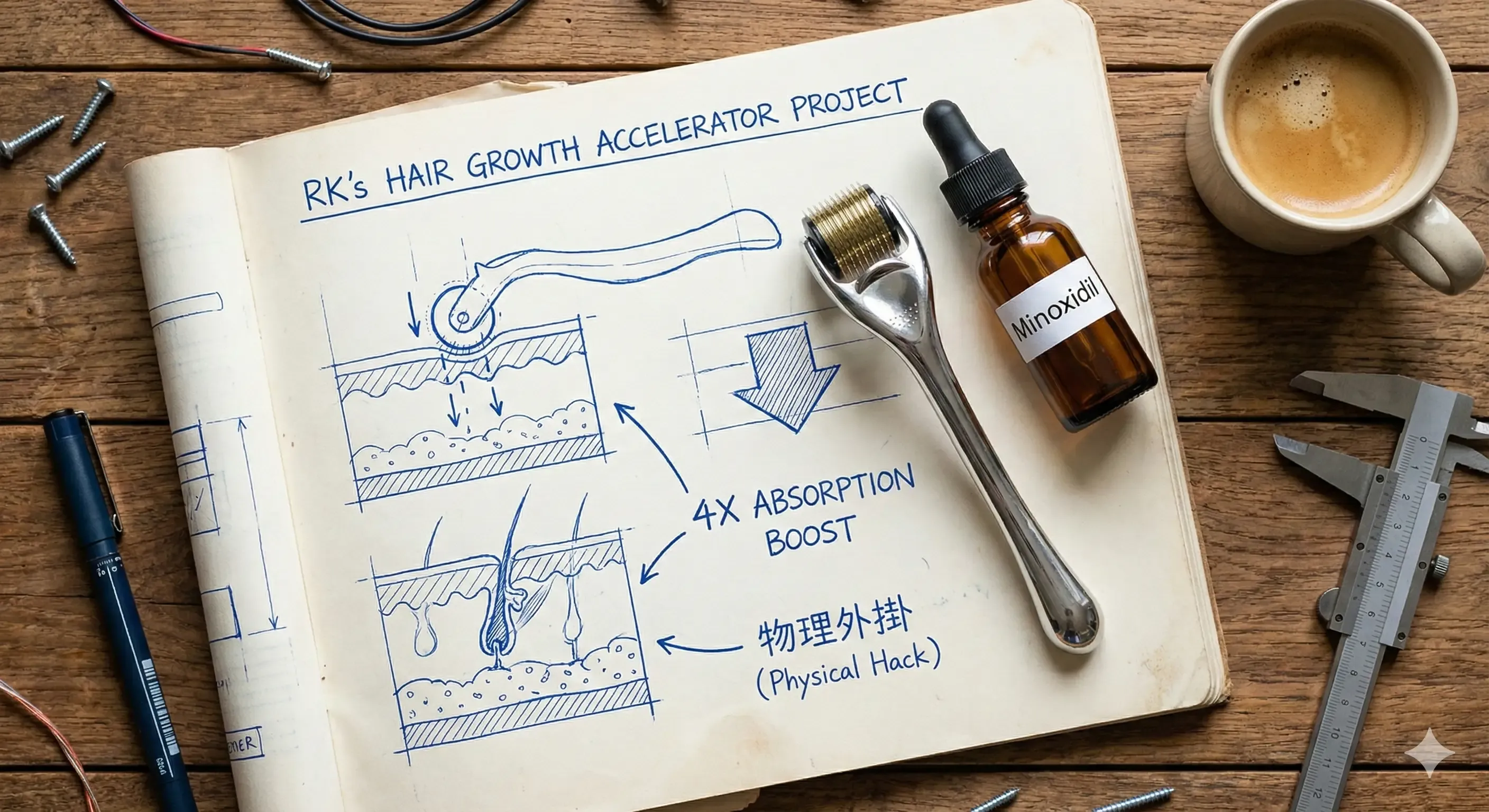
- Microneedling itself doesn't grow hair. It opens micro-channels in the stratum corneum so minoxidil actually reaches the follicle.
- 1.5 mm is the trial-tested needle length. Anything below 0.5 mm is essentially cosmetic; above 2.0 mm is clinical territory.
- Frequency: 0.5 mm weekly, 1.0–1.5 mm every 2–4 weeks. Skin needs healing time between sessions.
- Wait at least 30 minutes after rolling before applying minoxidil — the open channels would otherwise let too much through too fast.
Microneedling for Hair Loss: The Complete Dermaroller Guide (2026)
Last updated: May 2026 | Written by RK
If you’ve been on minoxidil for six months and the results feel underwhelming, the issue may not be the drug. It may be that the drug isn’t reaching the follicle.
Your scalp’s stratum corneum — the outer keratin layer — is engineered to keep things out. It’s why most topicals delivered to skin lose 90%+ of their active ingredient before it reaches the dermis. Minoxidil isn’t an exception. The Olsen 2002 trial measured +18.6 hairs/cm² at 5% twice-daily — but that’s the average across responders and non-responders. The non-responder rate sits around 30–50%, and a meaningful chunk of those non-responders are simply absorption failures.
This article is about the cheapest, best-evidenced fix for that problem: a 1.5 mm dermaroller used once every 2–4 weeks alongside your existing minoxidil routine.
How microneedling actually works
The mechanism has two parts, and most articles online only describe the first.
Part 1: Mechanical absorption boost
A dermaroller pierces the stratum corneum with hundreds of microscopic punctures, each typically 0.1 mm wide. These channels stay open for roughly 15 minutes to a few hours depending on needle length. While they’re open, topical minoxidil bypasses the keratin barrier entirely and reaches the dermis at concentrations multiples higher than passive absorption would deliver.
This is the primary reason microneedling boosts minoxidil efficacy. It’s not magic — it’s just delivering more drug to the right depth.
Part 2: Wound-healing biology (smaller effect)
The micro-injuries also trigger a localized wound-healing cascade: platelet-derived growth factor (PDGF), vascular endothelial growth factor (VEGF), and Wnt signaling all rise [1][2]. These growth factors plausibly contribute to follicle regeneration on their own, which is why some studies test microneedling without minoxidil and still see modest effects.
But the trials that produced the headline regrowth numbers all paired microneedling with minoxidil. Skip the minoxidil and you lose most of the benefit.
The cleanest mental model: Microneedling alone is a 5/10. Minoxidil alone is a 6/10. Microneedling + minoxidil is closer to 9/10. The combination multiplier is the whole point.
What the Dhurat 2013 trial actually showed
This is the foundational study everyone cites. It’s important to know both what it found and what its limitations are.
Setup (Dhurat et al. 2013, Int J Trichology, n=100) [3]:
- 100 men with mild-to-moderate androgenetic alopecia (Norwood 3-vertex or 4)
- Randomized into two groups of 50
- Group A: 5% topical minoxidil twice daily + weekly microneedling (1.5 mm)
- Group B: 5% topical minoxidil twice daily, no microneedling
- 12 weeks duration
- Hair count assessed in tattoo-marked 1 cm² area; global photos rated by blinded evaluators on a 7-point scale
Results at week 12:
Subjective response on the 7-point scale was even more striking: 82% of the microneedling group reported >50% improvement, vs 4.5% in the minoxidil-only group [3].
Methodology caveat worth flagging: Dhurat 2013 was evaluator-blinded — meaning the doctors scoring the photographs were blinded, but the patients knew which group they were in (you can’t really “fake” weekly rolling). This is weaker than double-blind because patient reporting is open to placebo effect, and adherence to twice-daily minoxidil might be higher in the rolling group simply because they’re more engaged with the protocol. The hair-count data (objective) survives this critique; the 7-point scale data (subjective) is more vulnerable.
What the 2025 meta-analysis confirms
A systematic review and meta-analysis published in Archives of Dermatological Research in 2025 pooled multiple microneedling + minoxidil RCTs [4]. The headline finding: the combination significantly outperforms minoxidil alone on hair density and patient-reported outcomes, with effect sizes consistent with the original Dhurat result. The 4× multiplier is on the high end of what’s been replicated; somewhere between 2× and 4× is the more conservative interpretation across the body of evidence.
Either way: the direction is robust. Adding a dermaroller meaningfully amplifies your minoxidil routine. This is one of the cleanest “more for free” findings in the AGA literature.
Picking a dermaroller — which needle length?
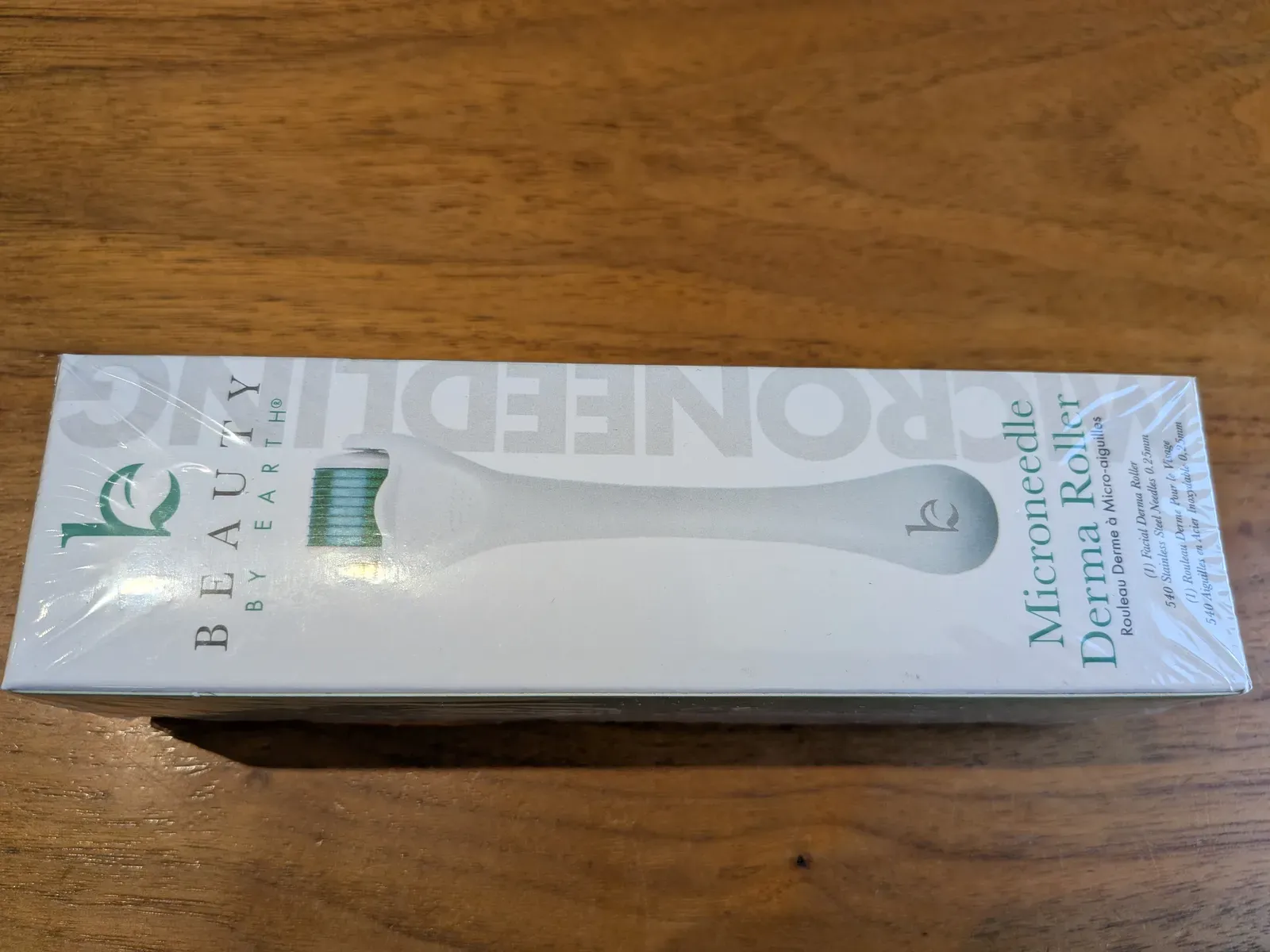
I have to admit something here. The first dermaroller I bought looked exactly like this — sealed retail box, “Microneedle Derma Roller” branding, professional-looking packaging. Only after I started reading the trial literature did I realize I’d bought a 0.25 mm roller, marketed for facial use. For AGA scalp treatment, that’s too short to reach the follicle depth where the action actually happens.
If you’re starting fresh, learn from my mistake: for hair loss specifically, you want 1.5 mm, not the 0.25 mm consumer-grade beauty roller. Both look identical in the box. The needle length matters more than the brand.
There’s a confusing range of dermarollers on the market with needles from 0.2 mm up to 2.5 mm. Here’s the practical mapping.
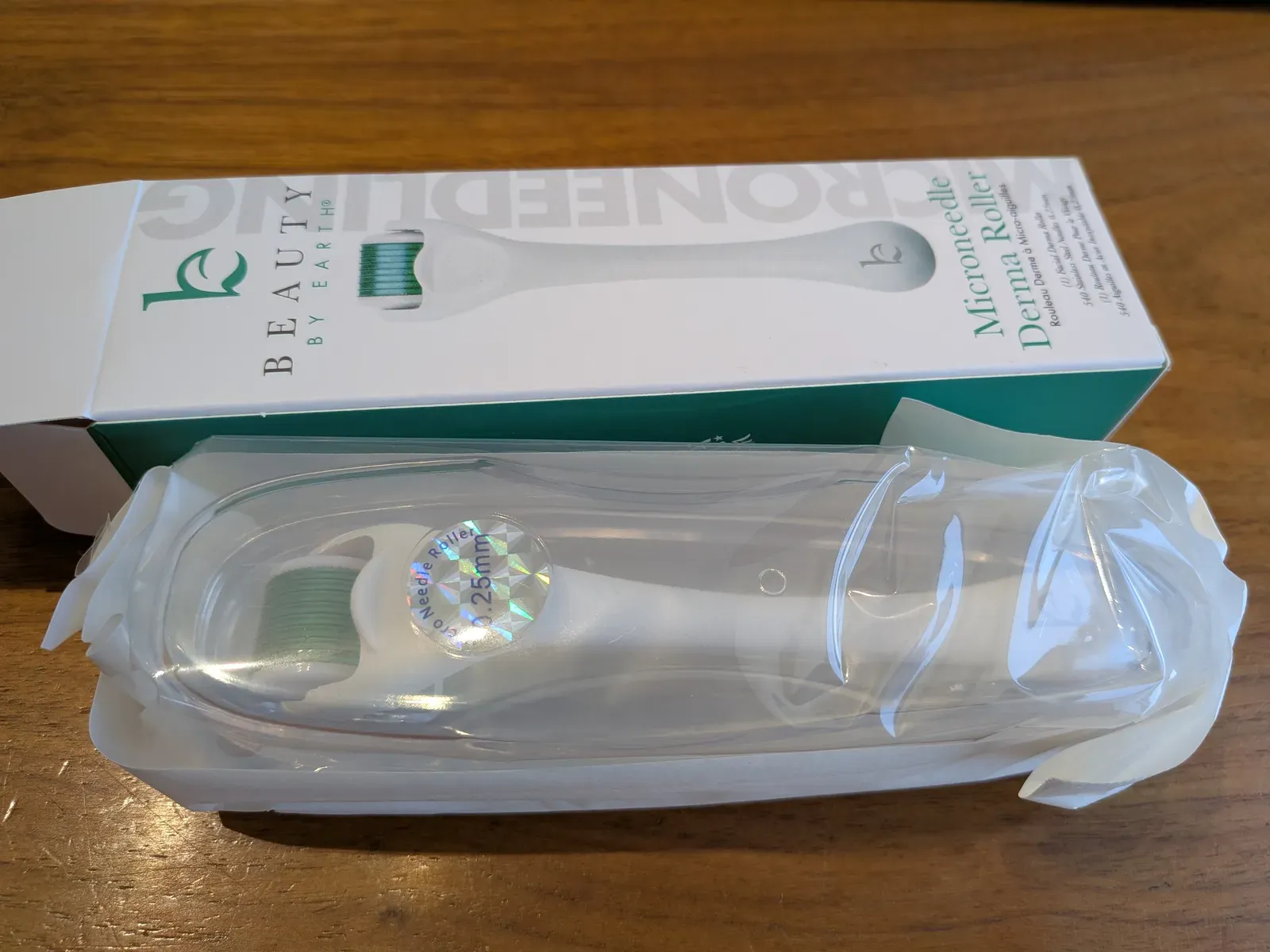
Sourcing: 1.5 mm titanium dermarollers from major brands run roughly $15–30 on Amazon. Don’t buy the $5 generic ones — needle bend and quality control are real issues, and a bent needle is a tetanus risk. Look for ISO 13485 medical-grade certification on the packaging.
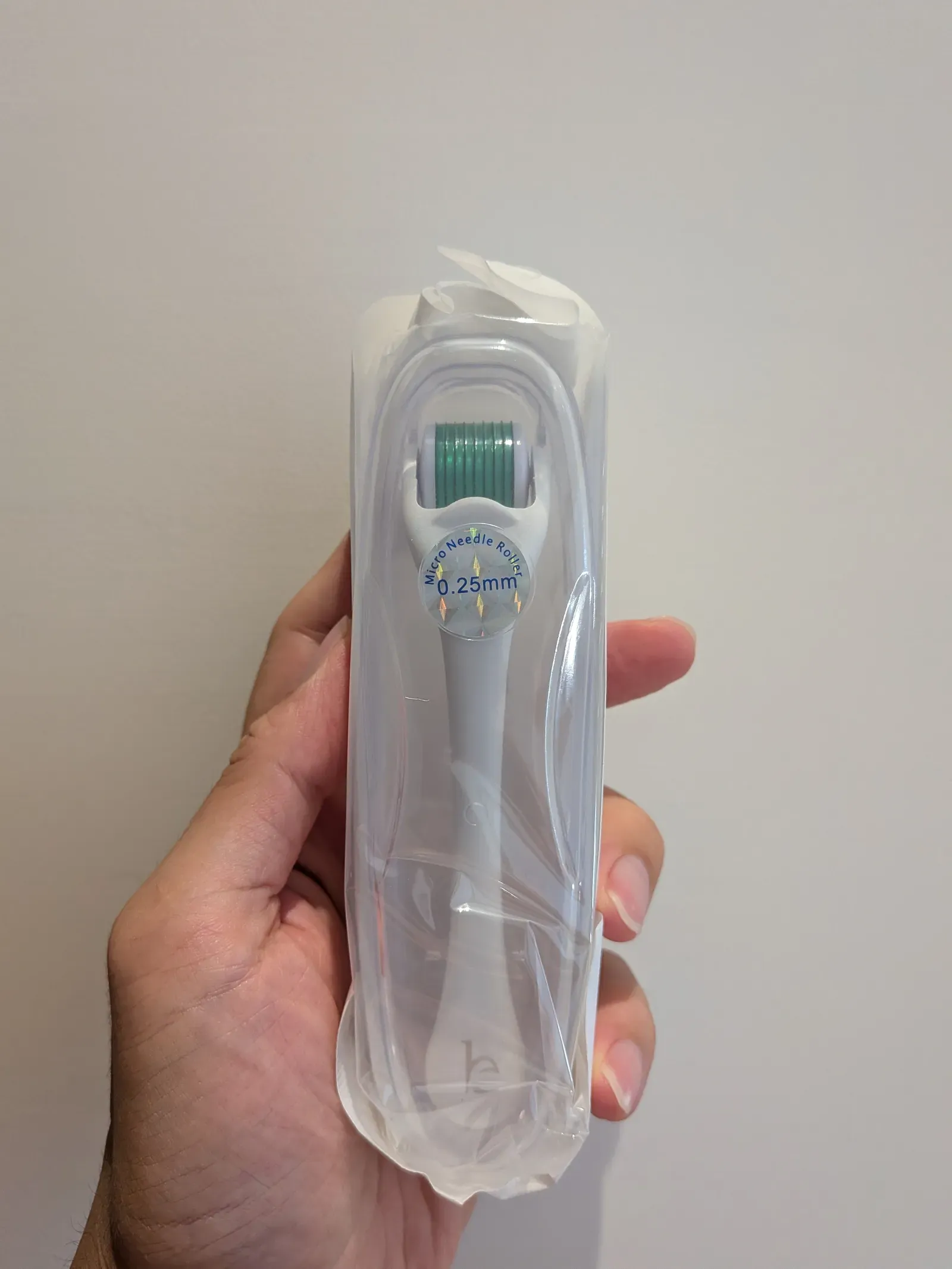
Always check the holographic sticker on the roller head before buying. The needle length is printed there. The product photo on the packaging shows a generic green roller; the sticker tells you the actual length.
Dermapen vs dermaroller: Dermapens (electric) are clinically equivalent to dermarollers when used at the same depth, with slightly better precision and less drag pain. They cost 5–10× more and aren’t necessary for at-home use. A good dermaroller works fine.
The protocol
This is what I do — adapted from the Dhurat trial protocol but with practical adjustments for home use.
Step 1 Wash hair with mild shampoo, dry fully. Scalp must be clean.
Step 2 Sterilize the dermaroller in 70% isopropyl alcohol for 5–10 minutes. Critical step. Skipping = infection risk.
Step 3 Roll over thinning areas: 8–10 passes in each direction (forward/back, left/right, then both diagonals). Light pressure — let the needles do the work.
Step 4 Wait at least 30 minutes. Channels narrow during this window. Going straight to minoxidil = unsafe systemic absorption spike.
Step 5 Apply minoxidil as normal. Skip the wait? Some users get headaches, dizziness, or palpitations from the absorption spike.
Step 6 Re-sterilize the roller after use. Store dry.
Step 7 Replace the roller every 10–15 sessions. Needles dull and bend with use; a dull roller bruises rather than punctures.
Frequency at 1.5 mm: every 2–4 weeks. The trial used weekly, but with 1.5 mm at home, 2 weeks is the safer floor. Skin needs that long to fully heal between sessions; rolling on inflamed skin causes more damage than benefit and can trigger fibrosis.
Safety — the parts that actually matter
Microneedling at home is a controlled minor injury — the safety profile depends entirely on how seriously you take sterilization and contraindications.
🛑 Don’t roll if:
- Active scalp infection, dermatitis, or seborrheic dermatitis
- Open wounds, recent surgery, or healing scabs in the rolling zone
- Bleeding disorders or on therapeutic anticoagulants (warfarin, full-dose aspirin)
- Active acne or rosacea on the scalp
- Keloid-prone skin (rare but real risk of hypertrophic scars)
⚠️ Stop and see a derm if:
- Redness or pain lasts more than 48 hours after a session
- Yellow/green discharge, fever, or expanding warm patches (infection signs)
- Persistent bleeding 5+ minutes after rolling
- Bumps that look like cysts forming at puncture sites
✅ Sterilization is non-negotiable
70% isopropyl alcohol soak for 5–10 minutes before AND after each use. Reusing a dermaroller without sterilization is the single biggest mistake home users make. Folliculitis from a contaminated roller can leave permanent scarring.
The “moderate redness for 24 hours” people describe is normal. The “persistent bleeding” or “pus” people sometimes describe is not — and is almost always traceable to either skipping sterilization or going too deep too often.
Stacking with other treatments
Microneedling is a multiplier for whatever topical you put on after. The most-studied stack is microneedling + minoxidil; the next most-studied is microneedling + finasteride/saw palmetto solutions.
The minoxidil stack is the path of least friction and best-evidenced result. Start there. See Minoxidil for Hair Loss: The Complete Guide for the topical setup.
When microneedling isn’t the right tool
The same caveats that apply to minoxidil apply here, with two additions:
You’re not on a topical to amplify
Microneedling alone has weak evidence. If you’re not also using minoxidil (or another topical AGA agent), microneedling probably isn’t worth the time and infection risk.
You can’t commit to sterilization discipline
If you’d skip the alcohol soak when you’re tired, don’t start. The infection risk dwarfs the regrowth benefit.
You have advanced AGA (Norwood 6–7)
Norwood 6–7 means extensive baldness with only the horseshoe ring of hair remaining. The follicles in fully bald areas are dormant or dead. Microneedling won’t revive them — hair transplant is the realistic path.
The decision card
You’re on minoxidil and plateaued at month 6+
This is the textbook microneedling case. Add a 1.5 mm dermaroller every 2–4 weeks. Expect noticeable improvement by month 3.
You’re starting fresh on AGA treatment
Start minoxidil first for 3 months. If results are visible, no need to add complexity. If results are flat at 3 months, add 1.5 mm microneedling every 2–4 weeks.
You’re a confirmed minoxidil non-responder
Microneedling can convert some non-responders into partial responders by fixing the absorption side of the equation. Worth a 12-week trial. If still nothing, the issue is sulfotransferase deficiency — switch to oral minoxidil.
Skip microneedling if
You won’t sterilize. You have active scalp dermatitis. You’re on blood thinners. You’re at Norwood 6–7. Or you’re not on any topical for the rolling to amplify.
What to read next
- Minoxidil for Hair Loss: The Complete Guide (2026) — microneedling pairs with topical minoxidil. Get the topical right first.
- Rogaine vs Kirkland Minoxidil (2026) — once you’ve decided to use minoxidil, this breaks down which brand and form to actually buy.
- Saw Palmetto for Hair Loss (2026) — the natural DHT blocker. Topical saw palmetto + microneedling is a viable stack for finasteride-averse users.
- Microneedling Results Timeline (2026) — what to expect month by month once you start.
- Microneedling Infection Prevention (2026) — the sterile-technique safety deep dive.
- Microneedling + Finasteride Stack (2026) — adding a topical 5α-reductase inhibitor to the protocol.
References
Disclaimer: This article is personal research and review. It is not medical advice. Microneedling at home carries real infection and skin-injury risk. If you have any active scalp condition, bleeding disorder, or are on anticoagulants, consult a dermatologist before starting. The 30-minute wait between rolling and minoxidil application is not optional — going faster has caused systemic side effects in users who tried it.