
LLLT and Red Light for Hair Loss (2026): What the Evidence Actually Shows
📌 TL;DR
- Low-level laser therapy (LLLT) is the most FDA-cleared device category in the hair-loss space — caps, helmets, and combs in the 630–680 nm red-light range. 'FDA-cleared' is a 510(k) device clearance, not a drug approval, and the standard is lower than what minoxidil or finasteride had to meet.
- The pivotal trials — Leavitt 2009 (LaserComb in men), Jimenez 2014 (LaserComb in men and women), Lanzafame 2013/2014 (TOPHAT in men and women) — all reported statistically significant hair-density gains over sham devices over 16–26 weeks. The effect is real; the magnitude is modest.
- Mechanism is photobiomodulation: red-light photons activate cytochrome c oxidase in follicle mitochondria, increase ATP, and appear to prolong the anagen growth phase. The biology is well-characterised; the cap-on-head version is harder to make precise.
- As an adjunct to minoxidil + finasteride, LLLT is reasonable and supported by a meta-analytic case for additive benefit. As a standalone alternative to the drugs, it under-performs them on every direct comparison.
- Devices range from around $200 for a basic comb to $1,500 for a premium helmet. Cost-per-hair compares unfavourably with generic minoxidil — but the no-systemic-drug profile is a real win for someone who cannot or will not take a drug.
LLLT and Red Light for Hair Loss (2026): What the Evidence Actually Shows
Last updated: June 2026 | Written by RK
Low-level laser therapy occupies a strange spot in the hair-loss landscape. It has more FDA-cleared devices than any other intervention category — caps, helmets, and combs in dozens of brand variations — and a positive sham-controlled trial base going back to 2009. By the standards of the hair-loss aisle, that is real evidence. And yet it is treated by most dermatologists as a cautious adjunct rather than a first-line treatment, because the effect size in head-to-head terms is modestly behind minoxidil and well behind finasteride.
This article walks through what LLLT actually is, what the four pivotal trials show, how the device landscape sorts out, where the stack with minoxidil and finasteride sits in 2026, and the honest cost-vs-benefit question. For context on the broader treatment landscape, see best hair loss treatments; for the drug comparisons, see minoxidil and finasteride vs dutasteride.

Low-Level Laser Therapy (LLLT) for Androgenetic Alopecia
CLM-COND-androgenetic-alopecia-INT-low-level-laser-therapy-001
≥1 quality MA + ≥3 consistent RCTs; society conditional recommendation.
- Professional Society — stance: supportive
"We suggest using LLLT as ancillary therapy for AGA with devices that use energy levels shown to be effective in randomized controlled clinical trials. [↑ Recommendation strength: 'We suggest'; Level of evidence 2]. O — We cannot make a reco…"
Source → - U.S. FDA — stance: supportive
"Treatment of androgenetic alopecia"
Source → - PubMed (NIH)
"Efficacy and safety of a low-level laser device in the treatment of male and female pattern hair loss (Jimenez 2014 HairMax LaserComb)"
Source → - PubMed (NIH)
"The growth of human scalp hair mediated by visible red light laser and LED sources in males (Lanzafame 2013)"
Source → - PubMed (NIH)
"Low level light-minoxidil 5% combination versus either therapeutic modality alone in management of female patterned hair loss: A randomized controlled study"
Source → - PubMed (NIH)
"Low-level laser therapy as a treatment for androgenetic alopecia"
Source → - PubMed (NIH)
"Efficacy of low-level laser therapy in androgenetic alopecia: a meta-analysis of randomized controlled trials (Liu 2019)"
Source →
What LLLT actually is
“Low-level laser therapy” is one of several names for the same thing — others include photobiomodulation therapy (PBMT), red light therapy, and cold laser. All describe the use of light at specific wavelengths (typically 630–680 nm red light, sometimes extending into 800–850 nm near-infrared) at power levels too low to heat tissue but high enough to interact with photoreceptive molecules in cells.
The hair-loss application is built on a single mechanistic claim: red light, delivered at the right wavelength and dose to the scalp, activates cytochrome c oxidase in the mitochondria of hair-follicle cells, increasing ATP availability and supporting prolonged anagen (growth-phase) activity. The biology is straightforward; the engineering is making sure the photons get to the follicle in the right dose.
The biological story is well-characterised in vitro and in animal studies. The translation to a real scalp wearing a real cap for 20 minutes three times a week is harder to make precise — which is why the trial data, while consistently positive, shows modest rather than dramatic effect sizes.
The evidence base — four pivotal trials
Four sham-controlled RCTs (Leavitt 2009, Jimenez 2014, Lanzafame 2013/2014) — positive, modestThe published-trial backbone of the LLLT-for-hair-loss case is four randomised sham-controlled studies, all reporting statistically significant hair-density increases vs sham devices.
- Leavitt 2009 — pivotal trial of the HairMax LaserComb in 110 men with androgenetic alopecia, 26 weeks of 3-times-per-week use at 655 nm. Significant increase in mean terminal hair density vs sham; this trial supported the original FDA 510(k) clearance for the device [1].
- Jimenez 2014 — multicenter sham-controlled trial of the HairMax LaserComb in 128 men and 141 women with pattern hair loss, 26 weeks. Significant treatment-vs-sham improvement in terminal hair density in both sexes [2].
- Lanzafame 2013 — sham-controlled trial of a 655 nm laser cap (TOPHAT) in 44 men with AGA, 16 weeks of every-other-day sessions. Active arm showed a 39% increase in terminal hair counts over the sham arm — one of the largest reported effect sizes in the LLLT literature [3].
- Lanzafame 2014 — companion sham-controlled trial of the same TOPHAT-style device in 42 women with FPHL, 16 weeks. Significant improvement in hair counts vs sham, mirroring the 2013 men’s result [4].
The consistency matters. Across four trials, two devices, both sexes, both pattern hair loss subtypes, and 16–26 week timepoints, the direction of effect is uniformly positive. That is the strongest part of the case.
The caveats matter equally:
- The effect sizes vary widely between trials — Lanzafame’s 39% terminal-hair increase is well above what Leavitt or Jimenez reported. Single-trial outliers should be read carefully, and the meta-analytic average is closer to “modest” than “dramatic.”
- Sham control in light-therapy trials is hard. Participants in many trials can feel a slight warming from the active device but not from sham, which compromises blinding. The Lanzafame trials used inactive devices that looked and felt identical, which strengthens that subset of evidence.
- The trials enrolled mild-to-moderate AGA — Norwood II–IV in men, Ludwig I–II in women. Generalisability to advanced loss is limited.
Subsequent reviews, including the broader photobiomodulation literature in dermatology, have placed LLLT in the “moderate evidence, real but modest effect” category — which is what the engine verdict above reflects.
The device landscape
The market sorts into four real categories:
What actually matters when picking a device:
- FDA 510(k) clearance number — confirms the device was reviewed for safety and substantial equivalence to a predicate cleared device. This is not a drug approval but it does mean the regulatory floor has been cleared.
- Wavelength — 630–680 nm red light is the trial-supported range; some devices add 800+ nm near-infrared with mixed evidence.
- Diode count — for caps/helmets, more diodes mean better scalp coverage; ≥80 is reasonable. For combs, density matters less because the device is moved across the scalp.
- Return policy — the honest answer for any individual is “it might not work for you.” A device sold without a return path is harder to justify.
What matters less:
- Brand prestige — much of the market is sold on marketing budget rather than clinical evidence beyond the original cleared predicate.
- “Combined NIR + red” claims — the trial base is overwhelmingly 630–680 nm red. Near-infrared addition is mechanistically plausible but trial-thin.
- Single-trial proprietary claims — many devices have one industry-funded study. The four trials cited above are the durable backbone.
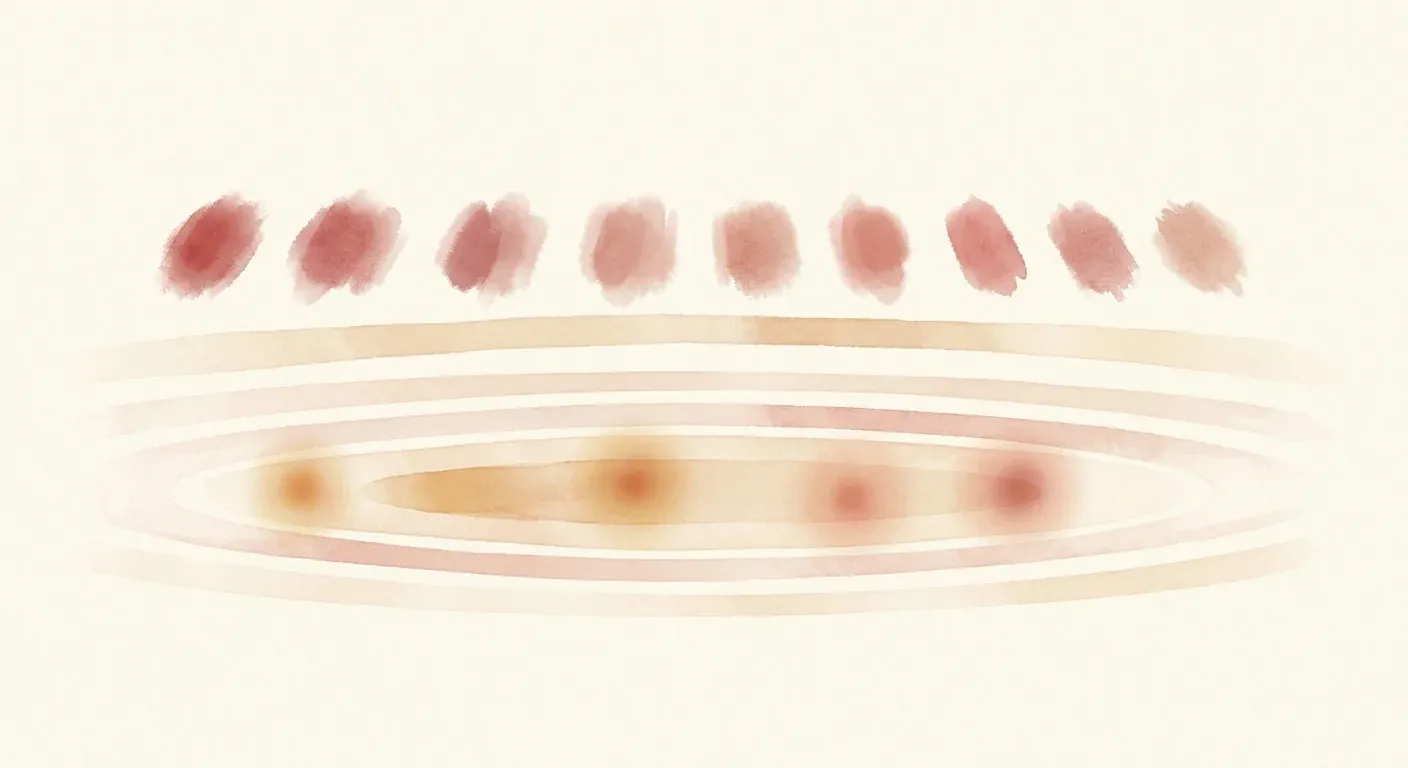
Red light at 630–680 nm penetrates a few millimetres into the dermis, reaching the follicle bulb where cytochrome c oxidase is thought to be activated. The mechanism is light-dose dependent; coverage is the engineering problem device design tries to solve.
Stacking LLLT with minoxidil and finasteride
The combination case is mechanistically clean — LLLT acts on the mitochondria, minoxidil acts on the potassium channels and vasculature, finasteride acts on 5α-reductase — and the trial literature, while smaller than the standalone LLLT case, supports additive benefit when LLLT is added to topical minoxidil.
A reasonable triple-stack protocol:
- Morning: 10–25-minute LLLT session (timing matches the device’s instructions)
- Daily: oral finasteride 1 mg (or whichever 5α-reductase strategy the user is on)
- Twice daily: topical minoxidil 5% to dry scalp (apply after the LLLT session if same time)
There is no drug interaction. The cost stack runs around $25–50/month for the drug portion (generic finasteride plus generic minoxidil) plus the one-time device purchase. For someone serious about treating progressing AGA, this is the most-aggressive non-procedural protocol short of adding microneedling.
Where LLLT fits
- • LLLT is the most-evidenced non-drug intervention
- • No systemic side effects
- • Effect is modest but real over 6 months of consistency
- • Mechanism does not overlap with the drugs
- • Stacking literature supports additive effect
- • Cost is one-time device rather than ongoing drug spend
- • Drugs have larger demonstrated effect sizes
- • Generic drug cost is well below any device
- • LLLT becomes worth adding only after the drug stack is in place
- • Trial enrollment was Norwood II–IV / Ludwig I–II
- • No LLLT trial has shown dramatic regrowth in advanced loss
- • Honest expectations matter — consider transplant consultation
The cost-vs-benefit reality
The cost case for LLLT only really works in two specific scenarios:
- As an adjunct on top of the drug stack — where the LLLT device is a one-time purchase adding a modest extra effect to the already-working drugs.
- As a substitute for the drugs when the drugs are off the table — where the comparison is “do something with evidence” vs “do nothing,” and LLLT wins that comparison.
The case that does not work is LLLT as a replacement for the drugs by preference. A year of topical minoxidil 5% generic costs about $120; a year of generic finasteride about $240. The combined evidence-based stack is well under $400/year with decades of RCT data behind it. A premium LLLT cap is $800–1,500 plus the time commitment of three sessions a week, with a smaller effect size and a shorter evidence base. The math does not favour the device unless one of the two specific scenarios above applies.
That is not a knock on LLLT — it is an honest assessment of where it sits. The technology is real, the trial evidence is positive, and the no-drug profile is genuinely valuable for the right person. But the marketing of premium devices often implies it is a drug-equivalent substitute, and the evidence does not support that claim.
What to read next
- Best Hair Loss Treatments (2026) — the decision-first overview with LLLT placed against minoxidil, finasteride, and microneedling.
- Minoxidil Complete Guide (2026) — the first-line topical the LLLT comparison keeps returning to.
- Microneedling + Finasteride Stack (2026) — the other “add a non-drug layer to the drug stack” intervention.
- Norwood Scale Explained (2026) — what stage actually matters for LLLT (mild-to-moderate, where the trials enrolled).
References
Disclaimer: This article is educational, not prescriptive. LLLT devices vary widely in build quality and the clearance status only addresses regulatory safety, not comparative efficacy. For anyone choosing a device, prefer FDA-cleared products with a return policy and the documented trial-supported wavelength range. As with any hair-loss intervention, a board-certified dermatologist remains the right starting point for staging and ruling out non-pattern causes.