DHT and Hair Loss: How It Works, Why It Targets Some Follicles (2026)
📌 TL;DR
- DHT (dihydrotestosterone) is made from testosterone by 5α-reductase. It's roughly 5× stronger at binding the androgen receptor than testosterone itself.
- Why some follicles fall: scalp follicles inherit different androgen-receptor sensitivity. Genetically vulnerable follicles miniaturize over each hair cycle when exposed to DHT.
- Imperato-McGinley 1974: men born without working 5α-reductase never develop pattern baldness. This is the cleanest single piece of evidence that DHT, not testosterone, is the driver.
- Finasteride blocks Type II 5α-reductase (~70% scalp DHT reduction). Dutasteride blocks both Type I and Type II (~94% reduction). Saw palmetto blocks both weakly.
- DHT-blocking only helps living miniaturized follicles. Once a follicle has fully fibrosed (Norwood 6–7 zones, scarring alopecia), no drug regrows it.
DHT and Hair Loss: How It Works, Why It Targets Some Follicles (2026)
Last updated: May 2026 | Written by RK
DHT shows up in every hair-loss conversation. Most people know it stands for “dihydrotestosterone” and that it’s “the hair loss hormone.” Most people don’t know much past that — including, often, the dermatologist’s own patients.
This article is the canonical explainer. Five things by the end:
- Where DHT comes from and what it does in the body
- Why it attacks specific follicles and leaves others alone
- The Imperato-McGinley discovery that proved DHT (not testosterone) drives hair loss
- How DHT-blocking drugs actually work — and why they have side effects
- When blocking DHT will help you and when it won’t
What DHT actually is
DHT — dihydrotestosterone — is a steroid hormone produced from testosterone. It is not “made” by some special gland. Your body makes testosterone, and an enzyme called 5α-reductase converts a fraction of that testosterone into DHT, mostly in tissues where DHT does its work: skin, scalp, prostate, seminal vesicles.
Two facts that explain almost everything about its role in hair loss:
-
DHT is roughly 5× stronger than testosterone at binding the androgen receptor [1]. The same dose of androgen, expressed as DHT instead of testosterone, has 5× the biological effect on receptor-bearing cells.
-
Different tissues have different 5α-reductase activity. Sebaceous glands and skin: Type I isoform. Scalp follicles, prostate, genital skin: Type II isoform. Hair on the back of the head has lower androgen-receptor density than hair at the crown — same person, same circulating hormones, different vulnerability.
So when people ask “why is DHT bad for hair?” — it isn’t, intrinsically. DHT does the same work that built your beard, deepened your voice in puberty, and developed your genitals. The problem is that specific scalp follicles are genetically programmed to react to DHT by miniaturizing. Those follicles read the same hormonal signal as a “shrink yourself” instruction instead of a “grow” instruction.
Testosterone vs DHT at a glance
| Property | Testosterone | DHT |
|---|---|---|
| Source | Leydig cells (testes), adrenal cortex | Conversion of testosterone via 5α-reductase |
| Plasma concentration (adult male) | ~300–1000 ng/dL | ~30–85 ng/dL (much lower) |
| Androgen-receptor binding affinity | Baseline | ~5× stronger |
| Receptor dissociation rate | Faster (released quicker) | Slower (sustained signal) |
| Required for fetal external genital development | Indirectly | Yes — directly |
| Required for puberty voice/muscle changes | Yes | Mostly via local conversion |
| Required for sebum, body hair, prostate growth | No (DHT does this) | Yes |
| Drives androgenetic alopecia | No (per Imperato-McGinley) | Yes — the proximate cause |
The key takeaway: lower plasma concentration but stronger and longer-lasting receptor signal makes DHT the dominant androgen at follicle and prostate tissue.
Why some follicles miniaturize and others don’t
This is the part most articles fudge. The honest answer:
Genetic inheritance determines which follicles are sensitive. Specifically:
- Androgen receptor (AR) gene on the X chromosome — sons inherit X from mother, so the popular “you inherit baldness from your mother’s father” rule has a real basis (though it’s not the whole story).
- Multiple risk genes beyond AR — genome-wide association studies have identified 20+ loci associated with male pattern baldness [2]. The picture is polygenic, not single-gene.
- Receptor density and 5α-reductase expression differ by follicle location — vertex (crown) and frontal hairline have higher AR expression and Type II 5α-reductase activity than donor zones (back/sides).
This explains the Hamilton-Norwood pattern of male pattern baldness: receding temples, then crown, then both spread until only the donor horseshoe remains. The pattern isn’t random — it traces the genetic vulnerability map of the scalp.
It also explains why hair transplantation works: surgeons move follicles from the DHT-resistant donor zone to the DHT-sensitive bald zone. The transplanted follicles retain their original DHT resistance even after relocation. Genetic identity travels with the follicle.
What this means practically: You can’t change your genetic susceptibility. But you can change DHT levels (drugs) or change DHT delivery (microneedling absorption modulators). Both reduce the pressure on vulnerable follicles, slowing or reversing miniaturization.
Why drug choice matters: 5α-reductase Type I vs Type II
The two enzyme isoforms occupy different tissues. Knowing which dominates where explains why finasteride (Type II only) and dutasteride (both types) produce different effects:
| Tissue / region | Type I activity | Type II activity | Targeted by |
|---|---|---|---|
| Scalp hair follicles (vertex, frontal) | Low | High | Finasteride, Dutasteride |
| Sebaceous glands (skin, scalp) | High | Low | Dutasteride (partial via Type I) |
| Prostate gland | Low | High | Finasteride, Dutasteride |
| Genital skin | Low | High | Both |
| Donor zone (back/sides of scalp) | Low–moderate | Low | Naturally protected |
| Liver | High | Low | Mostly unaffected |
This is why dutasteride reduces sebum more aggressively than finasteride — the Type I block hits sebaceous glands. It’s also why finasteride alone is often sufficient for AGA: scalp follicle DHT is mostly produced by Type II, and finasteride blocks ~70% of total scalp DHT despite being Type II–selective.
The miniaturization process
When a vulnerable follicle is exposed to DHT cycle after cycle, it doesn’t die at once. It shrinks gradually:
Cycle 1 Anagen (growth phase) shortens. Hair grows for fewer months before shedding.
Cycle 2–3 Hair shaft thins. The same follicle now produces a thinner, finer hair (vellus-like).
Cycle 4+ Hair becomes barely visible. Follicle is alive but producing peach-fuzz quality fiber.
End stage Follicle fibroses (scars over). Now permanently dead. No drug regrows it.
A typical hair growth cycle is 2–6 years anagen → 2–3 weeks catagen → 2–4 months telogen → repeat. Miniaturization happens cycle-by-cycle, which is why hair loss feels gradual but irreversible: by the time visible thinning happens, those follicles have already been through multiple shrinking cycles. (For a phase-by-phase deep dive on the cycle itself, see The Hair Growth Cycle Explained (2026).)
The good news: as long as the follicle is alive, miniaturization is partially reversible. That’s the entire premise of finasteride and minoxidil. Block enough DHT (or otherwise nudge the cycle) and miniaturized follicles can produce thicker hair again on the next anagen.
The bad news: once the follicle has fibrosed, it’s gone. This is why aggressive AGA at Norwood 6–7 (extensive baldness with only the donor horseshoe remaining) doesn’t fully reverse with drugs — many of those follicles are past the point of return. Drugs can only preserve what’s still alive.
The Imperato-McGinley discovery — proof that DHT is the driver
This is one of the most underappreciated stories in dermatology, and it’s the cleanest single piece of evidence that DHT, not testosterone, drives androgenetic alopecia.
In 1974, Julianne Imperato-McGinley studied a group of children in the Dominican Republic born with 5α-reductase Type II deficiency [3]. These children:
- Had normal testosterone levels
- Had genitalia that appeared female at birth (because Type II is required for fetal genital development)
- Underwent partial masculinization at puberty (because Type I and circulating testosterone are still active)
- Never developed male pattern baldness, regardless of family history
- Never developed acne or BPH (benign prostatic hyperplasia)
The control group — same gene pool, same testosterone levels, but with functioning 5α-reductase — developed all of those things at typical rates.
The implication is unambiguous: testosterone alone is not sufficient to cause androgenetic alopecia. The conversion to DHT is the necessary step. This is also why finasteride (a 5α-reductase Type II inhibitor) was developed — the drug is essentially a pharmacological mimic of the Imperato-McGinley genetic state, applied selectively.
Why this matters for you: It means the drug class works on the right target. We’re not blocking some peripheral signal — we’re blocking the molecule that genetic experiments confirm is the proximate cause.
How DHT-blocking drugs actually work
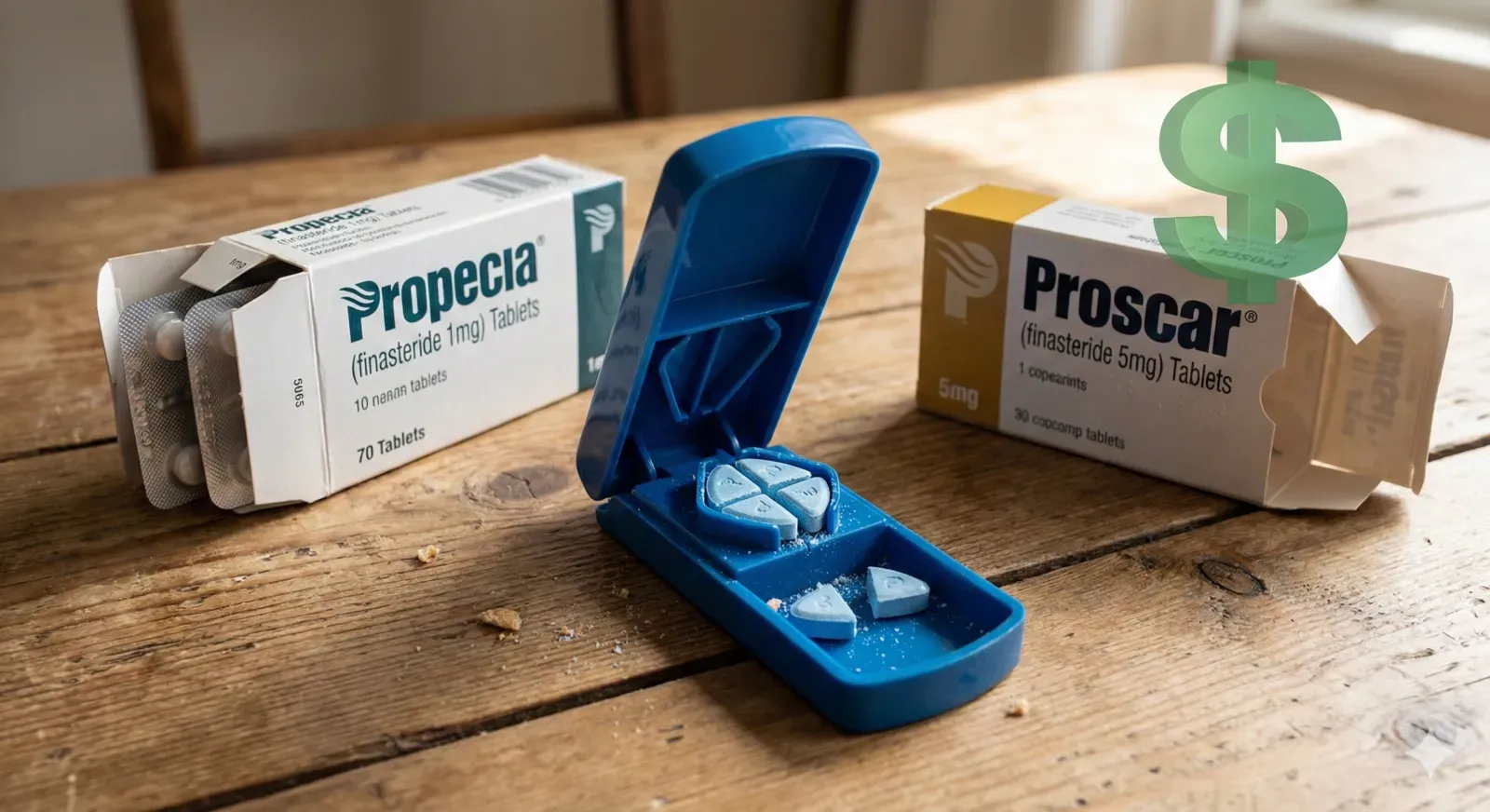
Three categories. The graphic below shows roughly how much circulating DHT each one knocks down at therapeutic dose:
At-a-glance comparison
| Drug | DHT block | Onset | Side-effect rate | Evidence | Best fit |
|---|---|---|---|---|---|
| Finasteride 1 mg | ~70% | 3–6 mo | 3–8% sexual (usually reversible) | Strong (RCT) | First-line for most AGA |
| Dutasteride 0.5 mg | ~94% | 3–6 mo | Slightly higher than finasteride | Strong (RCT) | Finasteride non-responders, aggressive AGA |
| Saw palmetto 320 mg | Weak (not directly measured) | 6 mo+ | Placebo-level | Moderate | Mild AGA, fin-averse, women |
Below, each option in detail.
Finasteride (1 mg/day for hair loss)
Selective inhibitor of 5α-reductase Type II. Reduces circulating (serum) DHT by approximately 71% at therapeutic dose [9]. FDA-approved for AGA in 1997.
Mechanism: blocks the enzyme that produces most scalp DHT. Type I (skin/sebaceous) is mostly untouched, which is why finasteride doesn’t dramatically reduce sebum production.
Onset: 3–6 months for visible scalp results. Plateau around 12 months.
Side effects (RCT data): ~3–8% report decreased libido, erectile difficulty, or reduced semen volume [4]. Most are reversible on cessation. A small subset (the “post-finasteride syndrome” debate) report persistent symptoms — controversial in literature, real for the people who experience it, mechanism not fully understood.
Dutasteride (0.5 mg/day, off-label for hair loss in US)
Inhibits both Type I and Type II 5α-reductase. Reduces circulating (serum) DHT by approximately 94.7% [10]. Originally FDA-approved for BPH; widely prescribed off-label for AGA.
Larger effect size than finasteride in head-to-head trials [5]. Also a higher rate of sexual side effects, longer half-life (so washout takes weeks).
Best for: finasteride non-responders, aggressive AGA where the larger DHT block matters.
Saw palmetto (320 mg/day standardized extract)
Weak inhibitor of both isoforms via a different mechanism (fatty acid competition rather than steroidal binding). Effect size approximately 50–60% of finasteride [6][7].
Best for: mild AGA, finasteride-averse users, women who can’t take finasteride. Side-effect rate matches placebo in trials. Less potent but much safer.
See Saw Palmetto for Hair Loss (2026) for the full breakdown.
Why blocking DHT also has sexual side effects
This is the question that scares most men away from finasteride, so it’s worth a clear answer.
DHT plays specific roles in adult male sexual physiology — it’s involved in libido drive, erectile signaling, and seminal vesicle function. Reducing circulating DHT by 70% (finasteride) or 94% (dutasteride) plausibly affects those systems in some users.
The clinical data:
- ~3–8% of finasteride users report at least one sexual side effect during treatment [4]
- Most cases resolve within weeks to months of stopping the drug
- A minority report symptoms that don’t resolve after stopping (“post-finasteride syndrome” or PFS) — incidence is debated, ranging from rare in some studies to a few percent in self-reported registries
- Mechanism for persistent symptoms is not fully understood — proposed contributors include neurosteroid synthesis changes, androgen receptor sensitization, and psychological/anxiety factors
This is why the dose matters. The 1 mg/day used for hair loss is much lower than the 5 mg/day used for BPH. Some users (and some prescribers) further reduce to 0.25 mg/day or every-other-day dosing — the dose-response curve plateaus around 1 mg, so reductions don’t sacrifice much efficacy but may reduce side-effect rates [8].
Bottom line on side effects: Most users tolerate finasteride well. A meaningful minority experience reversible side effects. A small minority report persistent symptoms. The risk-benefit calculation is genuinely individual — talk to a physician who’ll listen to your concerns rather than dismiss them.
When blocking DHT will (and won’t) help you
A useful mental model:
✅ DHT blocking helps when:
- You have androgenetic alopecia (genetic pattern hair loss)
- Your follicles are still alive but miniaturizing
- You’re at Norwood 1–5 (early to moderate-advanced loss)
- You’re committed to daily dosing for years (it’s a maintenance drug, not a cure)
❌ DHT blocking won’t help if:
- Your hair loss is from telogen effluvium (acute stress, postpartum, illness) — not androgen-driven
- You have alopecia areata (autoimmune patchy loss) — different mechanism, needs immunosuppressants or JAK inhibitors
- You have scarring alopecia (lichen planopilaris, frontal fibrosing alopecia) — follicles already dead
- Your AGA is at Norwood 6–7 in fully bald zones — most follicles past the point of return; transplant is the realistic option
The first action for any pattern of hair loss should be confirming the diagnosis. Treating the wrong condition with finasteride wastes 6 months you can’t get back if the actual cause was scarring alopecia or autoimmune.
Independent evidence verdicts on DHT-blocking drugs
The verdicts below come from a third-party evidence database that aggregates regulator positions, professional-society guidance, and meta-analyses for each intervention against androgenetic alopecia. Treat them as an independent reference for the two main DHT blockers discussed above.
Finasteride for Androgenetic Alopecia
CLM-COND-androgenetic-alopecia-INT-finasteride-001
Small RCT base, direction consistent but samples small; "may consider".
- Professional Society — stance: supportive
"The U.S. Food and Drug Administration (FDA) approved this medication to treat male pattern hair loss. When taken as directed, finasteride can: Slow down hair loss [and] Stimulate new hair growth. Finasteride is a pill that you take once a d…"
Source → - U.S. FDA — stance: supportive
"Sexual dysfunction that continued after discontinuation"
Source → - NHS (UK) — stance: cautious
"Finasteride and minoxidil are the main treatments for male pattern baldness. ... Finasteride and minoxidil are not available on the NHS. ... Both can have side effects, and they do not work for everyone. ... For benign prostate enlargement,…"
Source → - WHO — stance: cautious
"Finasteride has an established WHO International Nonproprietary Name (INN). It is NOT listed on the WHO Model List of Essential Medicines (24th edition, 2025); BPH/androgenetic alopecia treatments are generally outside EML scope. VigiBase (…"
Source → - PubMed (NIH)
"Finasteride in the treatment of men with androgenetic alopecia (Propecia phase III pivotal)"
Source → - PubMed (NIH)
"Finasteride in the treatment of men with frontal male pattern hair loss (Leyden 1999)"
Source → - PubMed (NIH)
"Efficacy and tolerability of finasteride 1 mg in men aged 41 to 60 years with male pattern hair loss (Whiting 2003)"
Source →
Dutasteride for Androgenetic Alopecia
CLM-COND-androgenetic-alopecia-INT-dutasteride-001
≥1 quality MA + ≥3 consistent RCTs; society conditional recommendation.
- U.S. FDA — stance: supportive
"AVODART is a 5 alpha-reductase inhibitor indicated for the treatment of symptomatic benign prostatic hyperplasia (BPH) in men with an enlarged prostate to: improve symptoms, reduce the risk of acute urinary retention (AUR), and reduce the r…"
Source → - NHS (UK) — stance: cautious
"Dutasteride. Indications and dose — Benign prostatic hyperplasia. By mouth. For adult: 500 micrograms once daily, review treatment at 3–6 months and then every 6–12 months. ... Contra-indications: Women; children. ... Cautions: Patients sho…"
Source → - WHO — stance: not_addressed
"Finasteride and dutasteride: prostate cancer (WHO Drug Information / WHO Pharmaceuticals Newsletter signal communication)"
Source → - PubMed (NIH) — stance: positive
"Hair regrowth treatment efficacy and resistance in androgenetic alopecia: A systematic review and continuous Bayesian network meta-analysis"
Source → - PubMed (NIH) — stance: positive
"The efficacy and safety of dutasteride compared with finasteride in treating men with androgenetic alopecia: a systematic review and meta-analysis"
Source → - PubMed (NIH) — stance: mixed
"Effectiveness and Safety of Intralesional Dutasteride in Patients With Androgenic Alopecia: A Systematic Review and Meta-Analysis"
Source → - PubMed (NIH) — stance: positive
"Long-term safety and efficacy of dutasteride in the treatment of male patients with androgenetic alopecia"
Source →
What to read next
- Best Hair Loss Treatments in 2026 — the decision tree for pairing DHT blockers with topicals.
- Saw Palmetto for Hair Loss (2026) — the natural DHT blocker. Realistic substitute for finasteride at ~50–60% strength with placebo-level side effects.
- Minoxidil for Hair Loss: The Complete Guide (2026) — DHT blockers and minoxidil hit different mechanisms. Most-studied stack pairs them.
- Finasteride for Hair Loss: The Complete Guide (2026) — the standard drug that puts the DHT mechanism above into practice.
- Finasteride vs Dutasteride (2026) — the two ways to block 5α-reductase, and when escalation makes sense.
- The Norwood Scale Explained (2026) — staging the pattern loss that DHT drives.
References
[1] Wilson JD. “The role of androgens in male gender role behavior.” Endocr Rev. 1999;20(5):726-737.
Disclaimer: This article is personal research and review. It is not medical advice. Decisions about taking finasteride, dutasteride, or any prescription medication should be made with a licensed physician who can evaluate your individual risk factors. Post-finasteride syndrome is a real concern for some users — if you have a history of mood disorders, sexual dysfunction, or are concerned about long-term effects, raise that explicitly with your prescriber before starting.