Minoxidil Scalp Irritation in 2026: Why It Itches and How to Keep Treating
📌 TL;DR
- Minoxidil scalp irritation splits two ways: the common mild itchy/dry/flaky reaction is usually irritant — driven by the liquid's propylene glycol and alcohol carrier — while a true, patch-test-confirmed allergy is, by recent pooled evidence, more often to the minoxidil molecule itself.
- Two different reactions look similar: irritant contact dermatitis (dose-related, anyone can get it) and allergic contact dermatitis (immune-mediated, won't settle until the trigger is gone). PG causes both.
- First fix: switch to 5% foam — it drops propylene glycol entirely. That resolves most irritant reactions and any propylene-glycol allergy. If foam still irritates, the problem may be the minoxidil itself.
- If foam still irritates, the ladder is: compounded PG-free liquid → lower frequency → add a ketoconazole wash → switch to oral low-dose minoxidil (no scalp contact at all).
- Rule out look-alikes first — seborrheic dermatitis, scalp psoriasis, and normal early-treatment flaking all mimic a minoxidil reaction. A dermatologist patch test confirms a true PG or minoxidil allergy.
Minoxidil Scalp Irritation in 2026: Why It Itches and How to Keep Treating
Last updated: May 2026 | Written by RK
An itchy, flaky, or red scalp is the second-most-common reason people quit minoxidil — after unrealistic expectations. It’s also one of the most fixable: a lot of it is the carrier the drug is dissolved in, not the drug, and the carrier is changeable. The part worth getting right is telling that case apart from a genuine allergy to minoxidil itself, because the two need different solutions.
This is the deep-dive on minoxidil intolerance — what’s actually reacting, how to tell an irritant reaction from an allergic one, and the full ladder of fixes that lets most people keep treating. For the drug’s broader side-effect profile, see the minoxidil side effects article; for the drug itself, the complete minoxidil guide.
What’s actually reacting — the carrier or the drug?
The liquid minoxidil solution is, by volume, mostly propylene glycol (PG) and alcohol. Minoxidil itself is a small single-digit percentage. PG is in the formula because it’s an excellent solvent — it dissolves minoxidil and helps drive it through the stratum corneum into the dermis where the follicle lives.
Both the carrier and the drug can cause trouble, and the literature has shifted on which matters more.
Older case series and a newer pooled analysis point differentlyAn earlier case series (Friedman 2002) found propylene glycol — not minoxidil — was the contactant in the majority of its topical-minoxidil contact-dermatitis patients [1]. For years that shaped the standard advice: “minoxidil allergy is really PG allergy, switch to foam.”
The larger recent picture complicates it. A 2025 individual-participant-data meta-analysis pooled 99 patients with patch-test-confirmed allergic contact dermatitis to topical minoxidil across 46 studies and found the minoxidil molecule itself was the allergen in 74.7% of cases, with propylene glycol second at 17.1% [2].
How to reconcile the two: the common, mild, irritant-type reaction — stinging, dryness, flaking — is genuinely carrier-driven, and PG plus alcohol are harsh. But true, immune-mediated allergic contact dermatitis is, on the best current evidence, more often an allergy to minoxidil itself. That distinction decides whether switching formulation actually fixes the problem.
The foam still matters as a first step. Minoxidil foam carries the identical 5% active drug but drops propylene glycol entirely, using ethanol and cetyl alcohol instead — Olsen’s 2007 trial confirmed it works as a delivery vehicle [3]. Foam resolves irritant reactions and any PG allergy. It just can’t fix an allergy to the drug itself.
Irritant vs allergic — two reactions that look alike
“My scalp reacts to minoxidil” actually covers two distinct mechanisms, and telling them apart changes what you do.
Why it matters: an irritant reaction often settles by lowering frequency or switching to a gentler carrier. A true allergic reaction won’t — and if the allergen is minoxidil itself (the majority of patch-test-confirmed cases [2]), no change of formulation will help. The route of delivery has to change instead.
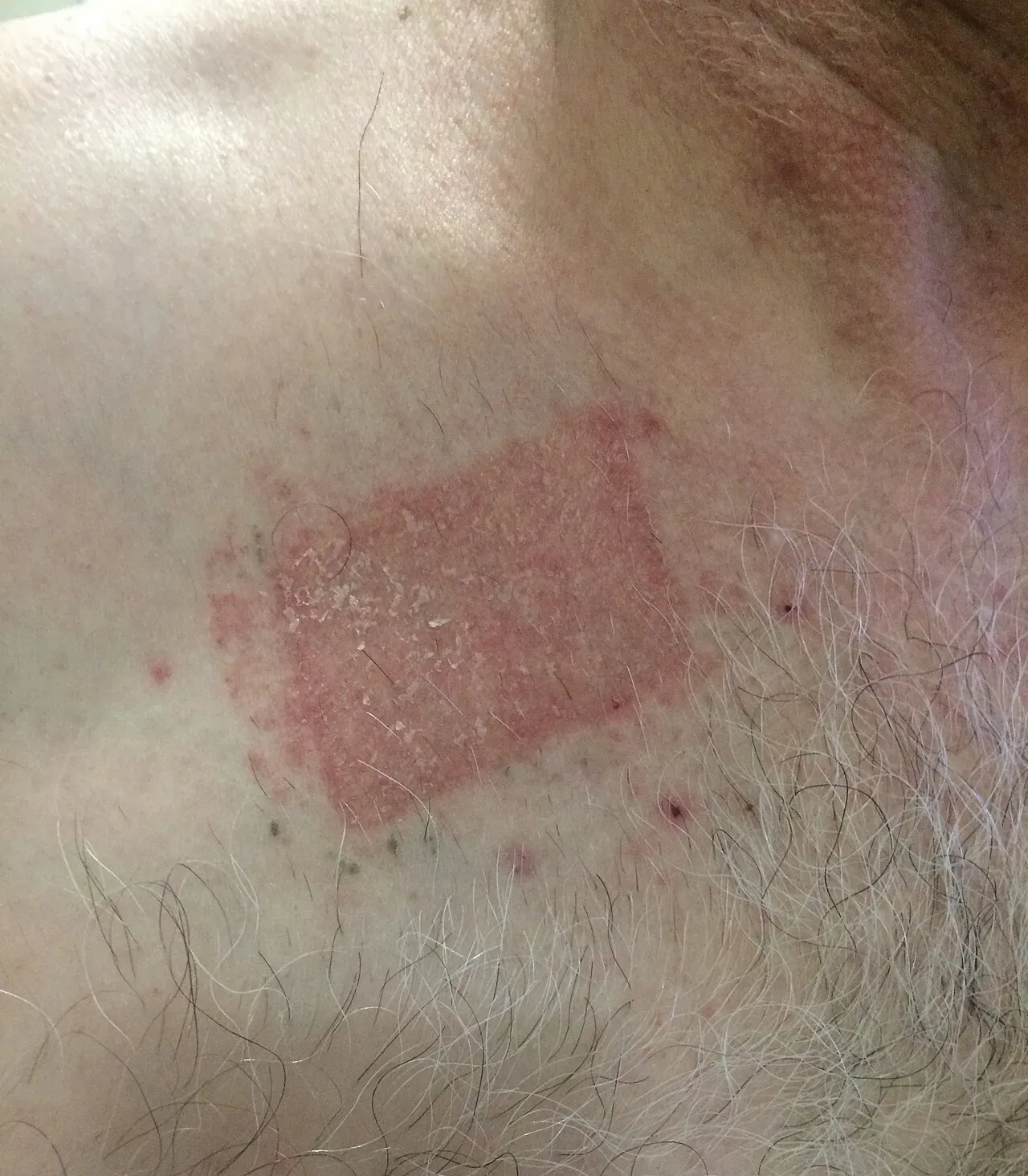
Severe contact dermatitis from a buprenorphine transdermal patch. Photo by Dr. khatmando, Wikimedia Commons, CC BY-SA 4.0. The sharply outlined reaction zone is typical of contact dermatitis — the same pathway behind PG-driven minoxidil reactions on the scalp.
First, make sure it’s actually a minoxidil reaction
Several common scalp conditions mimic a minoxidil reaction. Treating the wrong thing wastes months.
Seborrheic dermatitis
Greasy yellowish scaling, often along the hairline, eyebrows, and sides of the nose. Pre-dates the minoxidil or appears in areas you don’t treat. Common, and a confounder — it itches and flakes on its own.
Scalp psoriasis
Thick, well-demarcated silvery plaques, often beyond the scalp (elbows, knees). A chronic condition unrelated to the drug — and one that minoxidil alcohol can aggravate.
Normal early-treatment dryness
The alcohol in both liquid and foam is drying. Mild flaking or tightness in the first 1–2 weeks, with no real redness or intense itch, is often just that — and often settles.
The “dread shed” mistaken for a reaction
Increased shedding at weeks 2–8 is the drug working, not an allergy. It’s not itchy or red — if there’s no skin reaction, it isn’t intolerance.
If the picture is genuine contact dermatitis localized to where you apply minoxidil, and it tracks with application, the drug or its carrier is the likely cause. If it doesn’t fit that pattern, see a dermatologist before blaming the minoxidil.
Patch testing
The definitive test is a dermatologist-performed patch test — small amounts of suspected allergens (including propylene glycol, and minoxidil itself) are applied to the back under occlusion and read at 48 and 96 hours. It’s the only way to confirm an allergic contact dermatitis and to identify which component you’re reacting to. Worth doing if reactions persist across formulations, because it tells you definitively whether to chase a PG-free route or abandon minoxidil entirely.
The fix ladder
Work down this list — most people stop within the first two steps.
1 Switch to 5% foam. No propylene glycol. Same drug, same dose. Resolves the majority of cases in 2–4 weeks. Always the first move.
2 Compounded PG-free liquid. If foam’s ethanol still irritates, hair clinics and compounding pharmacies prepare minoxidil in gentler bases (e.g. with butylene glycol, glycerin, or hydroxypropyl cellulose).
3 Reduce frequency. For an irritant (not allergic) reaction, dropping to once daily can keep you under the irritation threshold while still getting most of the benefit.
4 Add a 2×-weekly ketoconazole wash. Lowers baseline scalp inflammation and treats any co-existing seborrheic dermatitis. See the ketoconazole guide.
5 Switch to oral low-dose minoxidil. The clean solution for true intolerance — no scalp contact at all, so no carrier to react to. Prescription-only. See the LDOM guide.
The key idea: scalp irritation almost never has to mean giving up minoxidil. It means changing how the drug is delivered. Oral LDOM in particular makes the entire carrier question disappear.
Allergy to minoxidil itself
Among patch-test-confirmed allergic contact dermatitis cases, allergy to the minoxidil molecule itself — not the carrier — is actually the majority [2]. The tell: irritation that persists even on propylene-glycol-free foam and on a compounded PG-free liquid, plus a positive patch test to minoxidil specifically (tested at 2% minoxidil in propylene glycol, the concentration the 2025 meta-analysis found most reliable).
This is the scenario where topical minoxidil is genuinely off the table — no carrier swap fixes an allergy to the active drug. But it doesn’t end treatment. Oral minoxidil is a different route, and a topical contact allergy does not reliably predict a problem with the oral drug. And minoxidil isn’t the only lever: a DHT blocker (finasteride, dutasteride, or saw palmetto) plus microneedling is a complete protocol that doesn’t involve minoxidil at all.
The decision
- • Resolves most cases in 2–4 weeks
- • Identical active drug and dose
- • Costs only a few dollars more per month
- • Patch test identifies the exact allergen
- • Rules out seborrheic dermatitis / psoriasis
- • An allergic reaction needs the trigger fully gone
- • Oral LDOM has zero scalp contact
- • A DHT blocker + microneedling works without minoxidil
- • Topical irritation should never force you off treatment entirely
What to read next
- Minoxidil Complete Guide (2026) — foam vs liquid, and the full how-to-use breakdown.
- Minoxidil Side Effects (2026) — the broader side-effect profile, with the dread shed and cat warning.
- Low-Dose Oral Minoxidil Guide (2026) — the no-scalp-contact route for the genuinely intolerant.
- Ketoconazole Shampoo for Hair Loss (2026) — useful as an anti-inflammatory adjunct for a reactive scalp.
References
Disclaimer: This article summarizes published evidence and is not medical advice. Persistent scalp dermatitis should be evaluated by a dermatologist — it may be a contact allergy, seborrheic dermatitis, psoriasis, or another condition, and patch testing is the only way to confirm a true allergen. Do not stop evidence-based hair-loss treatment over a formulation problem that can usually be solved.