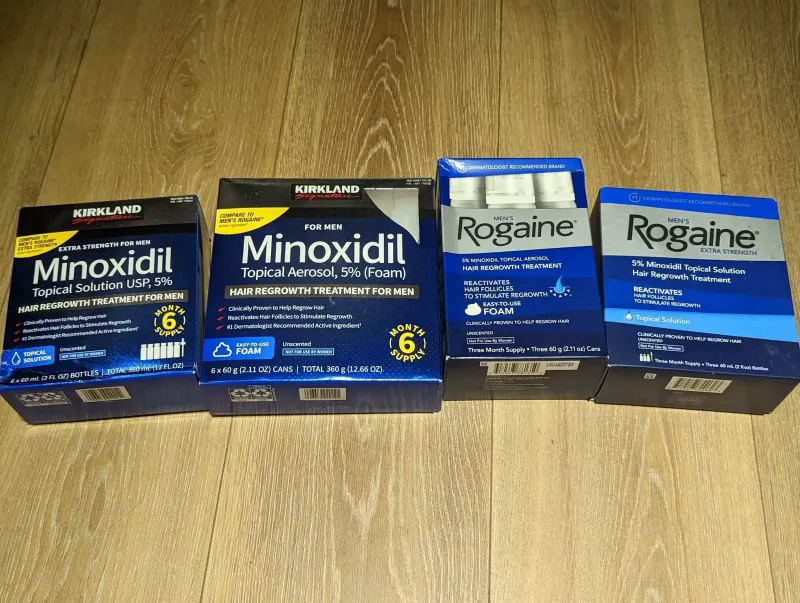
Rogaine vs Kirkland Minoxidil (2026): Same Drug, 1/3 the Price?
📌 TL;DR
- Both products contain identical 5% minoxidil — same FDA-approved active ingredient.
- In Olsen 2002 (n=393), 5% minoxidil grew +18.6 hairs/cm² vs +12.7 for 2% and +3.9 for placebo.
- Kirkland costs roughly 1/3 of Rogaine for the exact same active ingredient.
- Foam (no propylene glycol) causes far less scalp irritation than the liquid solution.
- Initial shedding at weeks 2–8 is normal — it's the synchronization phase, not failure.
Rogaine vs Kirkland Minoxidil (2026): Same Drug, 1/3 the Price?
Last updated: May 2026 | Written by RK
If you’ve started researching hair-loss treatments, you’ve already seen these two names — Rogaine and Kirkland. And you’ve already had the same thought I had three years ago:
“If the active ingredient is identical, why does Rogaine cost three times more? Am I taking a risk to save a few bucks on a generic?”
I tested both for over a year on my own scalp. Here’s the short answer, with the data.
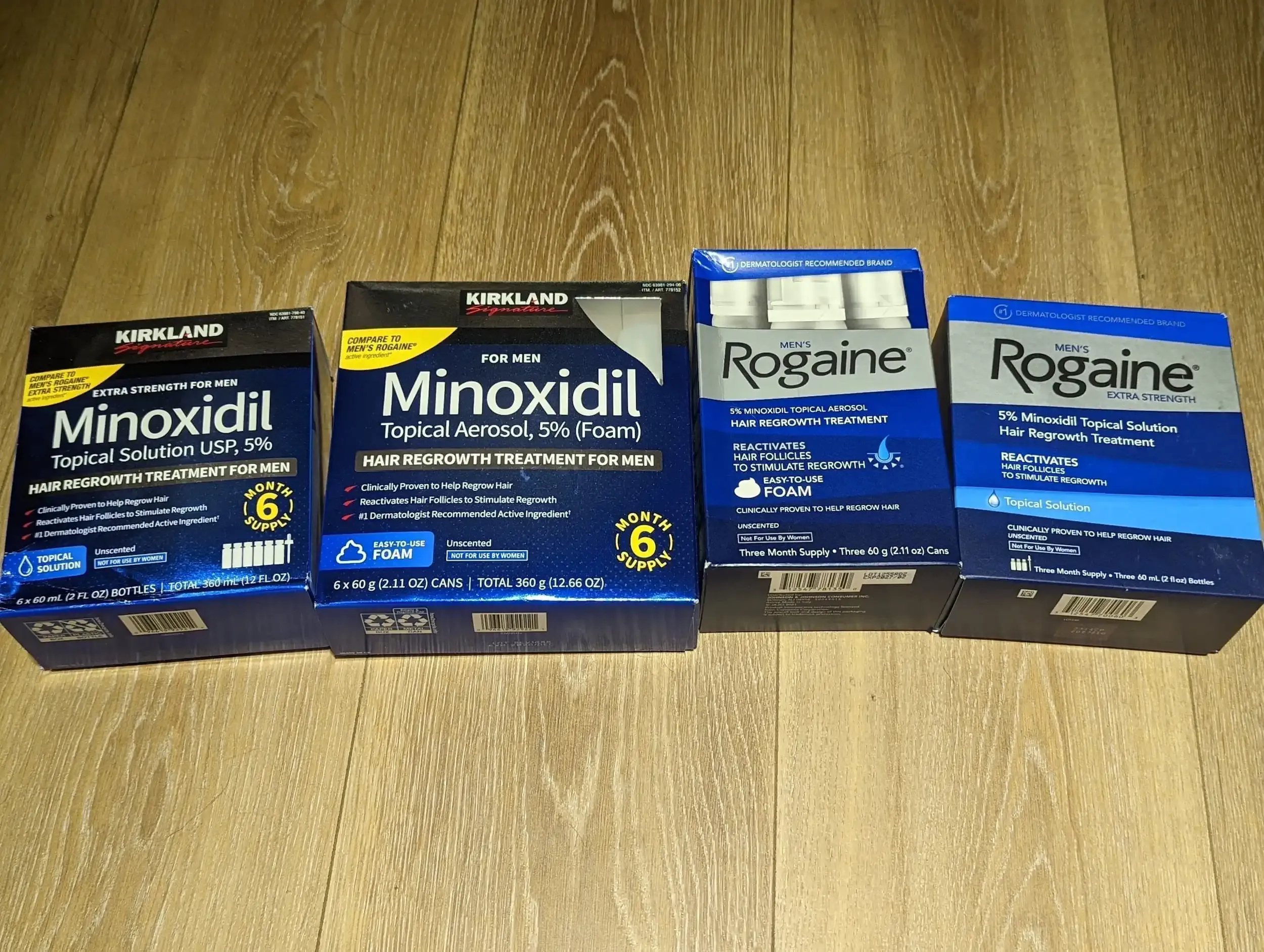
TL;DR — Skip the brand premium
Both products are 5% minoxidil. The active ingredient is literally identical.
The only meaningful differences are:
- Carrier solution (the inactive ingredients) — affects irritation
- Format (liquid vs foam) — affects ease of use
- Price — Rogaine costs roughly 3× more than Kirkland
If you’re sensitive to propylene glycol, get the foam version of either. If you’re cost-conscious, get Kirkland. The drug doing the work is the same molecule either way.
My recommendation: Kirkland 5% Foam. Same drug as Rogaine, no PG irritation, and ~$0.80/day instead of $2+/day.
What is minoxidil, actually?
Minoxidil was originally developed in the 1970s as an oral blood-pressure medication. Researchers noticed an unusual side effect: patients on it grew thicker hair. By 1988, the FDA had approved a topical 2% formulation for androgenetic alopecia under the brand name Rogaine [4].
The 5% version followed a few years later. Today, 5% topical minoxidil is the only FDA-approved over-the-counter treatment for hair regrowth — full mechanism breakdown in our minoxidil complete guide.
It works through two mechanisms most relevant to AGA:
- Vasodilation — opens up scalp microcirculation, delivering more nutrients to follicles
- Telogen shortening — pushes resting follicles back into the growth phase faster [3]
It does not address DHT (the hormonal driver of androgenetic alopecia). For that you need finasteride or dutasteride, or a 5α-reductase blocker like saw palmetto. Minoxidil and DHT-blockers are usually stacked — one shortens the heat, the other puts a lid on the pot. See our 2026 treatment overview for full decision logic.
Why 5%, not 2%?
The Olsen et al. 2002 trial is the cleanest head-to-head we have. They randomized 393 men with androgenetic alopecia across three groups for 48 weeks:
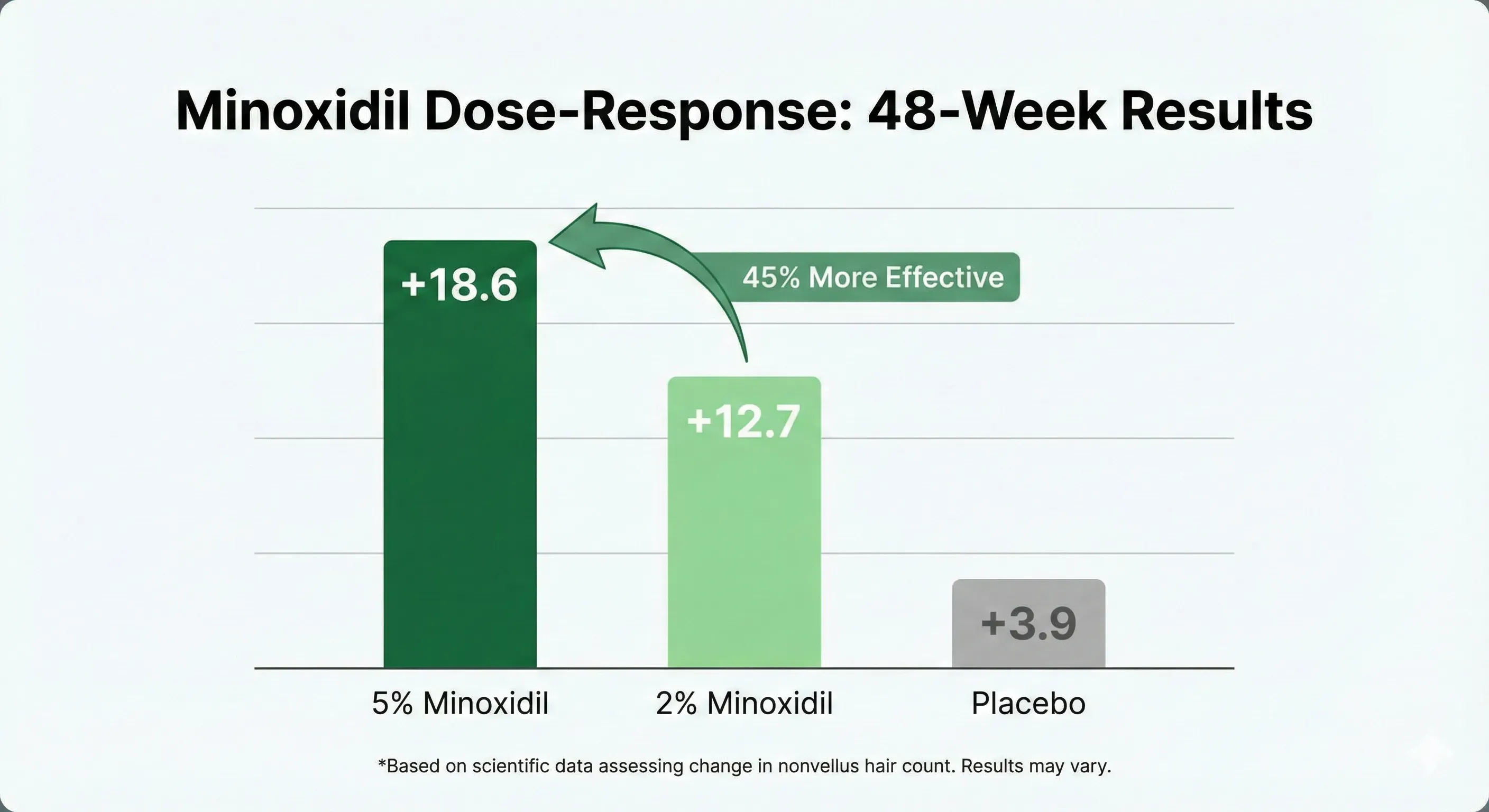
That’s a 45% improvement in hair count from 5% over 2% [1]. There’s no rational reason for a man to start at 2% (women may want to, due to higher facial-hair side effects at 5%).
A separate Olsen 2007 trial on 5% foam showed +21.0 hairs/cm² over 16 weeks [5] — slightly better than the liquid, likely because adherence was higher (foam is easier to use).
Solution vs Foam — pick by your scalp, not your wallet
Before picking a brand, pick the format. This decision matters more for whether you’ll actually keep using the product for 6+ months.
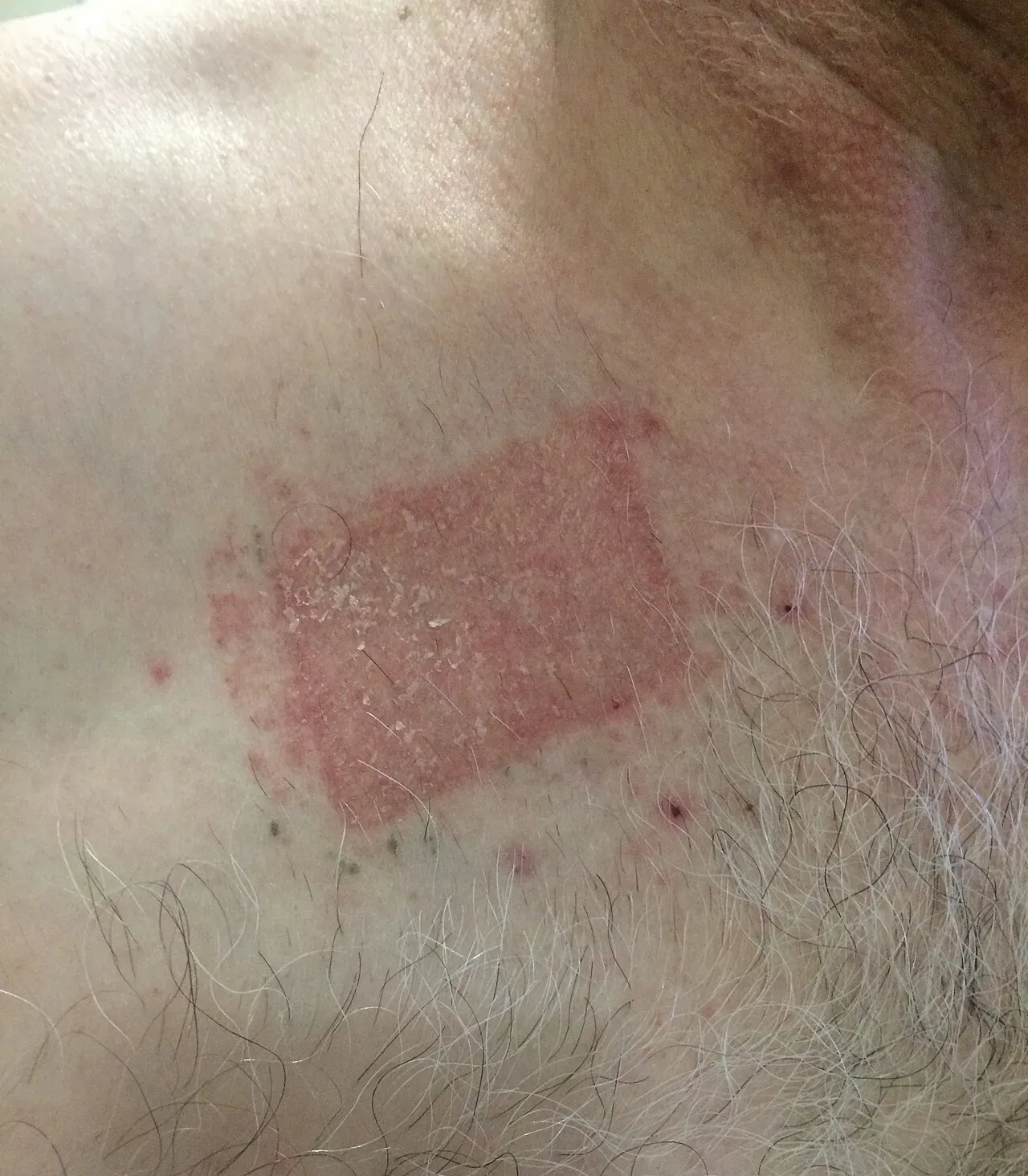
Severe contact dermatitis from a buprenorphine transdermal patch. Photo by Dr. khatmando, Wikimedia Commons, CC BY-SA 4.0. The PG-induced version on the scalp is more diffuse but mechanistically identical.
Liquid solution — cheap, but PG can sting
The liquid formulation uses propylene glycol (PG) as the carrier. PG dissolves minoxidil and helps it penetrate the stratum corneum, which is great for absorption — but it’s also the #1 cause of contact dermatitis on the scalp.
Pros:
- Cheapest format. Kirkland liquid is roughly $15–18/month.
- Dropper applicator reaches the scalp through long hair without waste.
Cons:
- Slow drying. 1–2 hours before you can comfortably wear a hat or sleep.
- High irritation risk. An estimated 6% of users develop PG-related contact dermatitis (clinical estimate; not a figure reported in [3], which is a mechanism review).
Best for: Cost-sensitive users, long hair, no history of scalp sensitivity.
Foam — clean, fast, no PG
The foam version uses ethanol/cetyl alcohol instead of PG. Same active ingredient, much friendlier carrier.
Pros:
- Dries in ~10 minutes. Practical for morning routines.
- Negligible irritation in most users.
- Slight visual volume from the residue (some find this a bonus).
Cons:
- Costs roughly 2× the liquid version.
- Foam melts on contact with body heat — for long hair, the foam often disappears before reaching the scalp.
Best for: Sensitive scalps, short hair, anyone who needs to apply in the morning.
2026 price comparison (US Amazon)
These are typical Amazon prices as of May 2026. They drift, so check before buying.
Note: A 60ml/60g bottle is roughly one month at twice-daily dosing.
Reading the table: Kirkland 5% Liquid is the cheapest active treatment for AGA on the consumer market — about $5–7/month. Even Kirkland Foam, with its better tolerability, is still ~1/3 the price of brand Rogaine. Unless you have a strong attachment to brand-name OTC drugs, Kirkland is the rational pick.
My personal protocol (3 years in)
I tried both products in different phases. Here’s what stuck:
Phase 1: Kirkland Liquid (cost-first)
First six months on a budget. The drug worked — visible regrowth at the temples by month four. But by month two I was getting persistent scalp itching, classic PG dermatitis. By month four, small flakes around the application area.
Phase 2: Switched to Kirkland Foam
Itching gone within two weeks. Drying time dropped from 90 minutes to 10 minutes — the practical difference for someone applying twice daily is huge. Cost went from $7/month to $9/month. Worth every cent.
Phase 3: Hybrid (current)
- Morning: Kirkland Foam (no PG, dries fast, off to work)
- Evening: Kirkland Liquid (cheap, dropper precision, scalp tolerates it overnight)
The hybrid optimizes for cost without sacrificing morning convenience.
Where to find these products
Both Kirkland 5% Minoxidil (Foam and Liquid) and Rogaine 5% Foam are widely available — Costco for Kirkland members, Amazon for either, and most US pharmacies stock Rogaine. If you’re new to minoxidil and your scalp tolerance is unknown, the foam version is the safer first purchase regardless of brand.
When the scalp itches anyway — three rescue moves
1. Switch to foam (the easy fix)
If liquid is itching you, switching to foam resolves it for ~90% of users. Pay the extra $3/month. You’ll actually keep using it.
2. The “melted foam” hack (long-hair workaround)
A trick from /r/tressless: if you have long hair (foam dissolves before reaching scalp) but can’t tolerate liquid (PG), do this:
- Pump a half-cap of foam into a small cup
- Let it sit 30 seconds — body heat from your fingers melts it into liquid
- Use a dropper to apply directly to the scalp
You now have PG-free “liquid” minoxidil. Not endorsed by Johnson & Johnson, but biochemically identical.
3. Anti-fungal shampoo on rotation
For mild irritation, rotate in a ketoconazole 1% shampoo (Nizoral) twice a week. It calms the inflammation without interfering with minoxidil. Not a cure, but a meaningful reduction.
The decision card
Tightest budget
Kirkland 5% Liquid (6-pack). ~$5–7/month. Cheapest viable AGA treatment, period. Tolerable if your scalp is fine with PG.
Best overall (my pick)
Kirkland 5% Foam (6-pack). ~$8–11/month. No PG, dries fast, identical drug to Rogaine Foam. The right answer for almost everyone.
Brand loyalty
Rogaine 5% Foam. Same active ingredient. Pay 2× more for the brand badge if it matters to you. No additional efficacy.
FAQ
Q: I’m using Kirkland but worried about counterfeits — is that a real risk? A: On Amazon, buy directly from “sold and shipped by Amazon.com” or from Costco’s official store. Avoid third-party sellers with no track record — there have been counterfeit reports for Kirkland minoxidil specifically because demand outstrips Costco’s supply.
Q: Can I combine minoxidil with finasteride? A: Yes, this is the most-studied combo (Rossi 2011 showed superior results to either alone). Topical minoxidil and oral finasteride work on different mechanisms — vasodilation/telogen-shortening vs DHT suppression. Most dermatologists recommend the stack for serious AGA. See your physician before starting finasteride.
Q: What if minoxidil isn’t working after 6 months? A: First confirm consistency — twice-daily for at least 24 weeks before judging. If genuinely ineffective, options include: adding microneedling (1.5mm derma roller, weekly), adding a DHT blocker, or switching to oral minoxidil under physician supervision. Don’t keep applying the same protocol that’s not working.
Q: Can women use 5% minoxidil? A: It’s FDA-approved at 2% for women, with 5% off-label. The 5% is more effective but causes more facial-hair side effects (Lucky 2004 [2]). Many dermatologists now use 5% off-label for women without complications, but discuss with your provider.
What to read next
- Minoxidil for Hair Loss: The Complete Guide (2026) — the full picture beyond brand choice: 5% vs 2%, foam vs liquid, oral vs topical.
- Low-Dose Oral Minoxidil (2026) — the pill alternative if the topical is a hassle.
- Minoxidil Side Effects (2026) — what to watch for whichever brand you pick.
- Best Hair Loss Treatments (2026) — where minoxidil fits in the evidence-graded plan.
References
Disclaimer: This article is personal research and review. It is not medical advice. Before starting minoxidil — especially if you have cardiovascular conditions, low blood pressure, or are pregnant — consult a licensed physician or dermatologist. Side effects, while rare, can be serious in a small subset of users.