Alopecia Areata vs Androgenetic Alopecia (2026): How to Tell Them Apart
📌 TL;DR
- Alopecia areata (AA) is an autoimmune condition — the immune system attacks hair follicles — producing sudden, well-defined round patches of complete hair loss on otherwise normal-looking skin. Androgenetic alopecia (AGA) is a hormonal/genetic condition producing gradual, patterned thinning. They are nearly opposite diseases that share only the word 'baldness.'
- The fastest tells: AA comes on suddenly in smooth round patches and can hit the beard, eyebrows, or lashes; AGA creeps in over years in a recognisable pattern (temples and crown in men, a widening part in women). AA's hallmark is the 'exclamation-mark hair' — a short broken hair that tapers toward the scalp — plus sometimes nail pitting.
- AA is often reversible because the follicle is attacked but not destroyed — many limited patches regrow within a year, sometimes spontaneously. AGA is progressive miniaturisation that worsens without treatment. This difference drives completely different management.
- Treatment diverges entirely. AA: intralesional corticosteroids for limited patches, and — the modern breakthrough — oral JAK inhibitors (baricitinib, ritlecitinib) FDA-approved for severe disease. AGA: minoxidil and finasteride. A drug for one does almost nothing for the other.
- If hair loss is patchy, sudden, smooth-skinned, or affecting beard/brows/lashes, it is not pattern baldness — see a dermatologist, because AA is treatable and is sometimes the first sign of other autoimmune conditions worth checking.
Alopecia Areata vs Androgenetic Alopecia (2026): How to Tell Them Apart
Last updated: June 2026 | Written by RK
These two conditions get filed under the same heading — “hair loss” — and almost nothing else about them is the same. Androgenetic alopecia is a slow, hormonal, genetically-driven thinning that follows a predictable pattern. Alopecia areata is a sudden autoimmune attack that carves out discrete patches and can strike a beard or an eyebrow as readily as a scalp. One is the most common cause of hair loss on earth; the other affects roughly 2% of people at some point in life. Confusing them leads to the wrong treatment, wasted months, and unnecessary worry.
This guide lays out the differences cleanly — cause, appearance, course, and treatment — so you can tell which conversation you are actually having. For the deep dives, see DHT and hair loss explained on the androgenetic side and the Norwood scale for pattern staging.
Two different diseases
The single most important thing to understand is that these conditions come from entirely different mechanisms.
In androgenetic alopecia (AGA), follicles that are genetically sensitive to dihydrotestosterone gradually shrink — a process called miniaturisation — producing the finer, shorter, lighter hairs that make a scalp look thin over years. There is no inflammation destroying the follicle; it is being slowly downsized by a hormone. This is covered fully in DHT and hair loss explained.
In alopecia areata (AA), the immune system loses its normal tolerance of the hair follicle and mounts a T-cell attack on the follicle bulb — described on biopsy as a “swarm of bees” of lymphocytes [1]. The follicle abruptly stops producing hair and the existing hair sheds, leaving a smooth bald patch. Crucially, the follicle is disabled, not destroyed — which is why the hair can regrow when the immune attack subsides [2].
How to tell them apart
The practical differential, feature by feature:
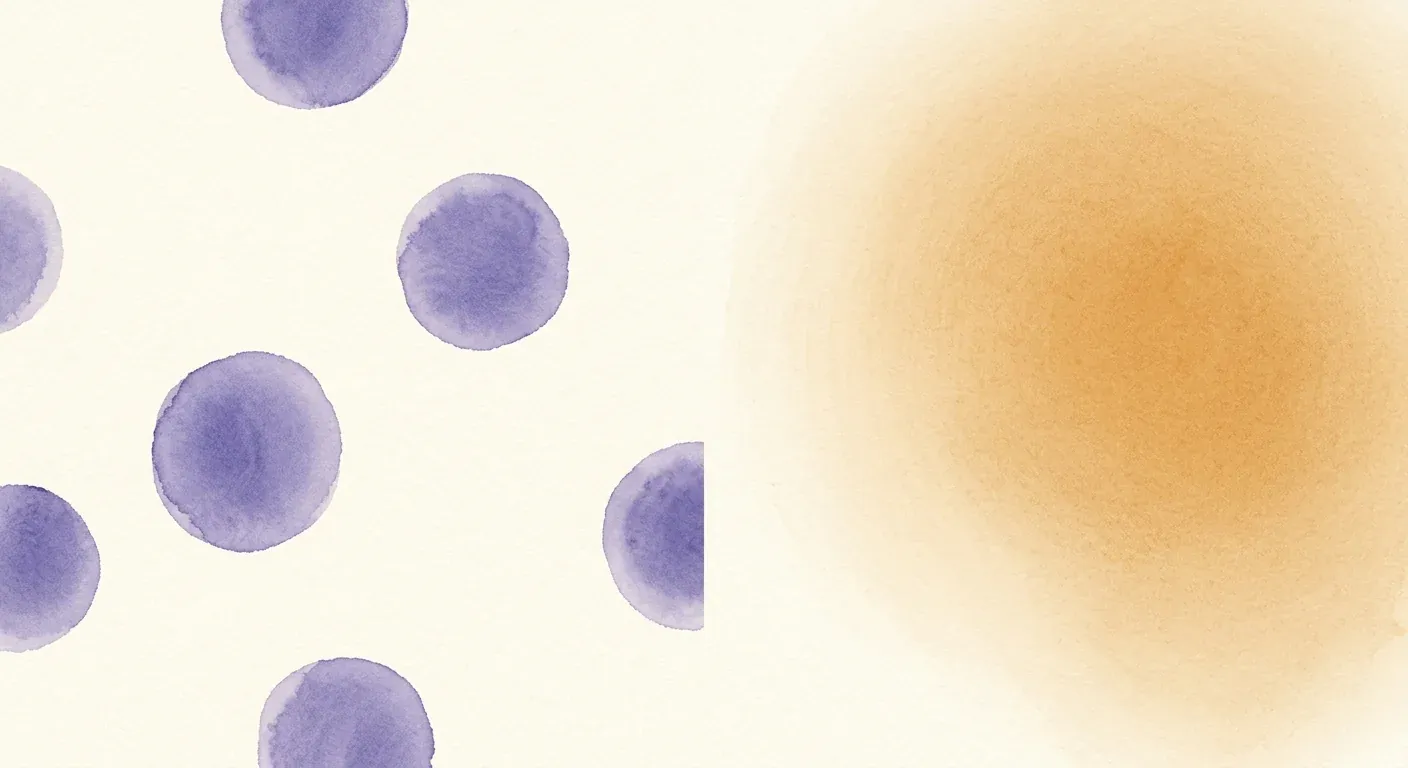
The visual shorthand: alopecia areata makes discrete round patches with a clean edge; androgenetic alopecia is a diffuse, patterned fade. The edge is the tell.
The exclamation-mark hair and other tells
A few specific features push the diagnosis toward alopecia areata, and they are worth knowing because they are quite specific:
- Exclamation-mark hairs — short broken hairs (a few millimetres) that are narrower at the scalp end than the tip, like an exclamation point. Found at the active edge of an AA patch, they are close to diagnostic.
- Smooth, normal skin in the bald area — no scaling, redness, or scarring. Scaling or scarring points away from AA toward an inflammatory or scarring alopecia, which needs different, more urgent assessment.
- Nail changes — fine pitting (tiny dents) or roughening of the nails accompanies AA in a subset of people, reflecting the same autoimmune process.
- Sudden, well-demarcated patches — you can run a finger to the edge and feel the transition. AGA has no such border; it fades.
- Beard, eyebrow, or eyelash involvement — pattern baldness does not do this; AA can.
- The “swarm of bees” on biopsy — if a biopsy is taken, the peribulbar lymphocytic infiltrate is the histological signature [1].
On trichoscopy (dermatoscope examination), a dermatologist additionally looks for yellow dots, black dots, and tapering hairs that confirm AA and distinguish it from the hair-diameter variability of AGA.
Course and treatment diverge completely
This is where the distinction stops being academic.
Alopecia areata is unpredictable but frequently favourable in limited disease — many single patches regrow within a year, sometimes with no treatment at all. Treatment is matched to extent:
- Limited patchy disease — intralesional corticosteroid injections are the usual first-line; topical corticosteroids and topical minoxidil are used as adjuncts.
- Extensive disease (alopecia totalis / universalis, or rapidly progressive) — the major recent advance is oral JAK inhibitors. Baricitinib was FDA-approved in 2022 for severe AA in adults on the strength of the large BRAVE-AA randomised trials, which showed meaningful scalp regrowth in a substantial fraction of patients [3]. Ritlecitinib followed in 2023 with approval down to age 12. These dampen the JAK-STAT immune signalling that drives the follicle attack — and because AA’s follicles are preserved rather than destroyed, even long-standing severe disease can respond.
- Contact immunotherapy (e.g. diphencyprone) remains an option for extensive disease in specialist centres.
Androgenetic alopecia, by contrast, is progressive and treated with the entirely different toolkit covered across this site: minoxidil, finasteride, and adjuncts. None of the AA treatments meaningfully help AGA, and none of the AGA treatments resolve an autoimmune patch. Getting the diagnosis right is the entire game.
What to do
- • Trichoscopy confirms AA quickly (exclamation hairs, dots)
- • Limited patches often respond to intralesional steroids
- • Early diagnosis avoids months of wrong (AGA) treatment
- • AGA is hormonal/genetic, not autoimmune
- • Minoxidil and finasteride are the levers
- • No need for an autoimmune work-up
- • Severe AA is no longer untreatable
- • JAK inhibitors require specialist prescribing and monitoring
- • Earlier treatment can improve the odds of response
- • AA skin is smooth; scarring/scaling points elsewhere
- • Scarring alopecia is a different, time-sensitive diagnosis
- • Permanent follicle loss is preventable only if caught early
The bottom line
If your hair loss is gradual and patterned, you are almost certainly in androgenetic-alopecia territory — slow, hormonal, treated with minoxidil and finasteride. If it is sudden and patchy on smooth skin, especially if it touches a beard or an eyebrow, that is the signature of alopecia areata — autoimmune, often reversible, and now backed by genuinely effective treatments for even the severe forms. The two conditions share a symptom and almost nothing else, and the single most valuable thing you can do is get the diagnosis confirmed by a dermatologist with a trichoscope before committing to any treatment. The right drug for the wrong diagnosis is just lost time.
What to read next
- The Norwood Scale Explained (2026) — staging for the androgenetic side, once AA is ruled out.
- DHT and Hair Loss Explained (2026) — the hormonal mechanism behind pattern loss.
- Telogen Effluvium: The Complete Guide (2026) — the third major “diffuse shedding” condition, distinct from both AA and AGA.
- Hair Loss Myths Debunked (2026) — what does and does not actually cause hair loss.
References
Disclaimer: This article is educational, not diagnostic. Distinguishing alopecia areata from androgenetic alopecia — and both from the scarring alopecias and telogen effluvium — reliably requires a board-certified dermatologist with trichoscopy and, occasionally, a scalp biopsy. The treatments differ completely, and some conditions in the differential are time-sensitive, so a clear diagnosis should come before any treatment decision.