
The Norwood Scale Explained (2026): How to Read Your Stage and What It Means
📌 TL;DR
- The Norwood-Hamilton scale (Hamilton 1951, modified by Norwood 1975) is the standard 7-stage visual classification of male androgenetic alopecia. Every modern hair-loss trial and most clinics use it.
- Stages I–II are baseline / minor recession. Stage III is the first formally 'balding' classification. Stage IV–V is moderate-to-advanced. Stage VI–VII is extensive — the recipient zone is approaching the limit of what minoxidil + finasteride alone can hold.
- Norwood IIIa / IVa / Va — the 'anterior variant' — describes loss that goes back across the top without the typical crown thinning. Same disease, different geometry. Often missed.
- The scale predicts treatment yield more honestly than people want it to. At Norwood II early intervention preserves a lot. At Norwood VI it preserves a little. Knowing where you actually sit changes the conversation with a dermatologist.
- The female equivalent is the Sinclair / Ludwig scale — different geometry (diffuse central thinning, not frontal recession). See the FPHL guide for that classification.
The Norwood Scale Explained (2026): How to Read Your Stage and What It Means
Last updated: May 2026 | Written by RK
The Norwood-Hamilton scale is the single most-used framework in hair loss — referenced in every modern trial, every dermatology clinic, every transplant consultation, every Reddit post that says “I’m a Norwood III going on IV.” Knowing what your stage actually is matters more than people realise: it tells you which trials enrolled people like you, what treatment yield to expect, and when transplant becomes a realistic option rather than an aspirational one.
This article unpacks the scale honestly — the history, the seven stages with the A-variants, how to self-assess without flattering yourself, and what each stage means for treatment. For the underlying biology, see DHT and hair loss explained; for the women’s equivalent, see the FPHL guide.
Where the scale came from
Hamilton 1951 + Norwood 1975 — foundational classificationsIn 1951, James B. Hamilton published a study at Yale describing the systematic patterns of male hair loss across 312 men, dividing the progression into 8 types from I (no loss) to VIII (extensive baldness) [1]. The Hamilton scale was the first to codify what dermatologists had long observed informally — that male pattern hair loss progresses through recognisable, reproducible stages.
In 1975, dermatologist O’Tar Norwood (working independently at the University of Oklahoma) refined Hamilton’s scheme into the seven-stage classification that is now the worldwide standard, adding the “anterior variant” A-stages and tightening the stage boundaries [2]. The combined scale is properly called the Norwood-Hamilton scale, though in casual use just “Norwood” suffices.
Why the scale endures: it’s clinically reproducible, it predicts treatment yield, and it’s the lingua franca of every published AGA trial. When Kaufman 1998 enrolled “men with mild-to-moderate hair loss” for the Phase III finasteride trial, that meant Norwood III–V; when modern microneedling trials report results, they classify enrollees by Norwood. The scale is the diagnostic floor of the field.
The seven stages
A useful framing: stage tells you what’s left, not what’s gone. Hair you’ve already lost can’t be retrieved by drugs alone. Treatment preserves and partially reactivates miniaturizing follicles — the ones that are still alive but producing thinner hair. The stage tells you how much of that biological raw material you have left to work with.
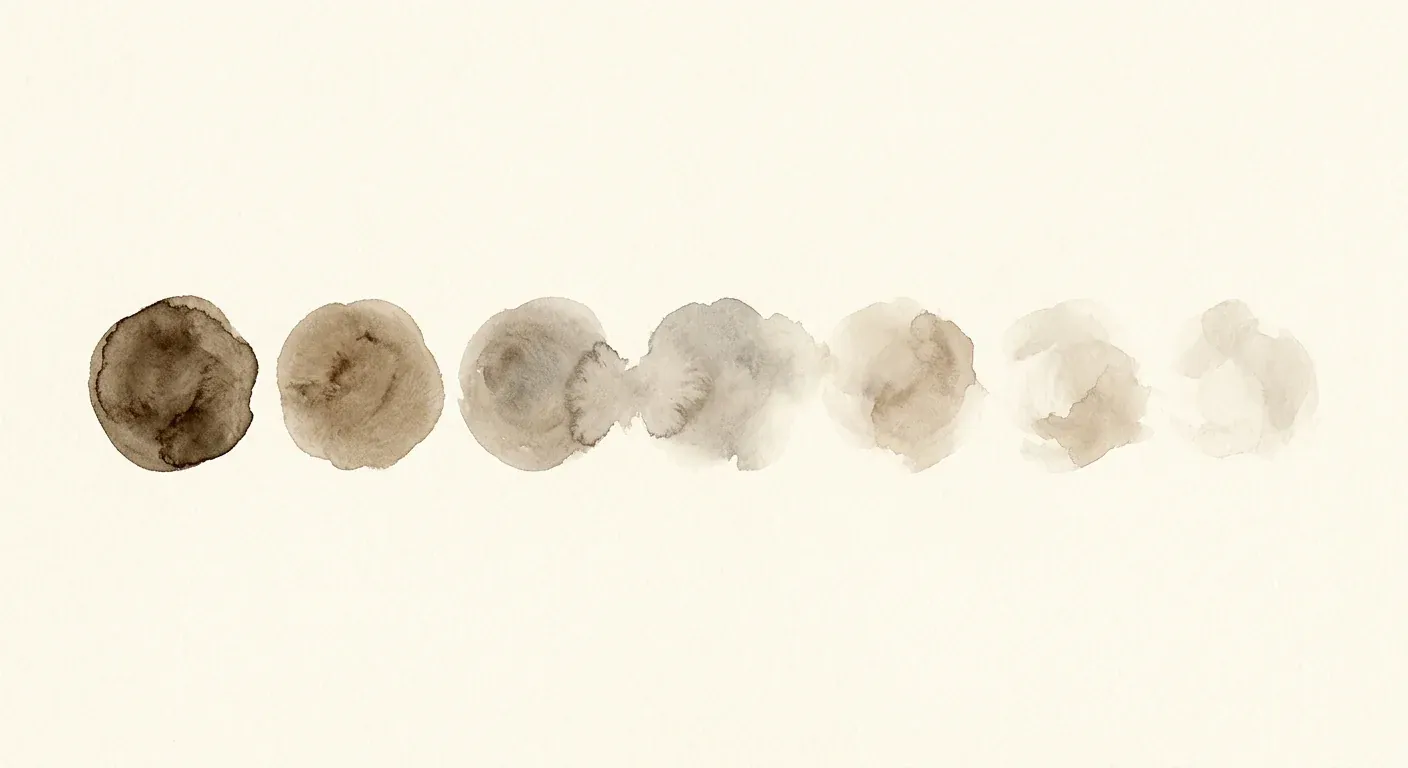
Norwood progression is a multi-year timeline. Most men spend 5–15 years moving across stages — which is also the window during which early treatment preserves the most.
The “A” variants — anterior loss without crown thinning
About 5–10% of male AGA progresses front-to-back without the usual crown component. The hairline retreats and the area immediately behind it thins, but the vertex stays intact for longer. Norwood codified this as the A-variants — IIIa, IVa, Va.
- IIIa: hairline has retreated past the imaginary line connecting the highest points of the ear canals, but no crown thinning.
- IVa: hairline has retreated past the midpoint of the scalp from front to back, still no crown loss.
- Va: hairline has retreated even further; the loss zone is almost the entire frontal half of the scalp; vertex still intact.
The underlying disease is the same androgenetic alopecia. The clinical difference is mostly cosmetic geometry — and transplant planning, since A-variants give the surgeon a different shape to work with.
How to self-assess (honestly)
The dermatology literature consistently finds that patients underestimate their own stage by about one step on average. The remedy is structured photography, not casual mirror checks.
1 Same room, same lighting (a north-facing window beats overhead bulbs), same time of day.
2 Wet hair combed straight back — wet because styling hides density.
3 Four angles: hairline straight on; top-down with head bowed (shows the crown); each side profile.
4 Compare those four photos to the published Norwood plates (any reputable hair-loss text or dermatology atlas). Don’t compare to friends.
5 If you can’t decide between two stages, you’re at the higher one. Underestimation is the systematic bias.
For anyone considering surgery, the stage assignment really needs a dermatologist’s trichoscopy — donor density assessment + miniaturisation pattern + ruling out conditions like FFA or diffuse unpatterned alopecia is not something a hand mirror can do.
What each stage suggests for treatment
- • Most men sit here for life
- • Drugs are maintenance commitments
- • Early intervention is for active progression, not static patterns
- • Trial evidence (Kaufman 1998, Olsen 2002) is anchored here
- • Preserving early gets you the best result
- • Every year of unchecked progression is follicle you lose
- • Drugs preserve what is left, can partially reactivate miniaturized follicles
- • Transplant becomes a real conversation once loss is stabilised
- • Don't skip drugs — transplant without ongoing meds unravels
- • Reactivation potential of bald zones is minimal
- • Donor density is the limiting factor, not surgical technique
- • Honest framing prevents disappointment
The limits of the scale
A few honest caveats every reader should hold:
- Pattern variation exists. Some men progress diffusely (top-down thinning without classic recession) and don’t fit any Norwood stage cleanly. That’s not a failure of the scale — it’s a sign to see a dermatologist for trichoscopy because diffuse unpatterned alopecia (DUPA) needs a different transplant consideration.
- Inter-rater reproducibility is good, not perfect. Two trained dermatologists scoring the same patient agree more than they disagree, but borderline cases routinely get scored half a stage apart.
- The scale doesn’t capture density well. A Norwood III with high baseline density and a Norwood III with already-thinned baseline density look very different even though they share the same classification.
- The female version is separate. The Sinclair scale (1–5) and the older Ludwig scale (I–III) classify FPHL by diffuse central thinning rather than frontal/crown geometry. See the FPHL guide.
- FFA can mimic frontal AGA in postmenopausal women. A receding hairline with eyebrow loss isn’t a Norwood pattern — it’s a different scarring condition. See the menopausal hair loss article for the differential.
What to read next
- DHT and Hair Loss Explained (2026) — the biology that drives Norwood progression in the first place.
- Best Hair Loss Treatments (2026) — the treatment overview, with stage-specific decision branches.
- Hair Transplant FUE vs FUT (2026) — what the stage-VI conversation actually looks like in a transplant consultation.
- Female Pattern Hair Loss Complete Guide (2026) — Sinclair scoring + diffuse pattern, the women’s equivalent.
References
Disclaimer: This article is educational, not diagnostic. Self-assessment is a starting point for a conversation with a board-certified dermatologist who can perform trichoscopy, evaluate donor density, and rule out conditions that mimic or coexist with androgenetic alopecia. Treatment decisions belong in that consultation, not on the basis of a stage estimate from a hand mirror.