Biotin for Hair Loss in 2026: The Myth, the Evidence, and a Real Safety Risk
📌 TL;DR
- Biotin supplements regrow hair only in people with a genuine biotin deficiency. Patel 2017 reviewed every published case of biotin helping hair — all 18 had an underlying deficiency or pathology. Zero evidence for healthy, non-deficient people.
- True biotin deficiency is rare in developed countries. The usual causes are genetic biotinidase deficiency, long-term anticonvulsants, prolonged raw egg-white intake, or chronic alcohol use — not 'not taking a gummy.'
- The serious risk: megadose biotin (the 5,000–10,000 mcg in hair gummies, 150–300× the 30 mcg adequate intake) interferes with lab immunoassays. The FDA has linked it to falsely low troponin that masked a heart attack, and to false thyroid panels.
- If you're shedding, the productive tests are ferritin, TSH, and vitamin D — not biotin. Treat the actual deficiency.
- If you take biotin for any reason, tell every doctor before bloodwork and stop it 2–3 days before any test.
Biotin for Hair Loss in 2026: The Myth, the Evidence, and a Real Safety Risk
Last updated: May 2026 | Written by RK
Biotin is the default hair supplement. It’s in every “hair, skin and nails” gummy, recommended by influencers, and stocked at every pharmacy. It’s also, for the overwhelming majority of people taking it, doing nothing for their hair — and the megadoses sold for hair growth carry a genuine, under-discussed safety risk that has nothing to do with your scalp.
This is the contrarian entry in the supplements series. Unlike saw palmetto or pumpkin seed oil, where the honest answer is “modest evidence, worth considering,” the honest answer on biotin is narrower: it works only if you’re deficient, deficiency is rare, and the megadose products can distort the lab test that detects a heart attack.
Biotin (Vitamin B7) for Hair Loss
CLM-COND-hair-loss-INT-bio-001
Cochrane / multiple MAs show no effect or harm — mainstream medicine against.
- NIH Office of Dietary Supplements — stance: supportive
"Signs of biotin deficiency include skin rashes, hair loss, and brittle nails. Therefore, biotin supplements are often promoted for hair, skin, and nail health. However, these claims are supported, at best, by only a few case reports and sma…"
Source → - U.S. FDA — stance: neutral
"Biotin in patient samples can cause incorrect lab test results. The FDA has received a report that one patient taking high levels of biotin died following falsely low troponin test results when a troponin test known to have biotin interfere…"
Source → - EFSA (EU) — stance: supportive
"Biotin contributes to the maintenance of normal hair / Biotin contributes to the maintenance of normal skin / Biotin contributes to the maintenance of normal mucous membranes — Article 13(1) authorised general function claims (Regulation (E…"
Source → - NHS (UK) — stance: cautious
"You should be able to get all the biotin you need by eating a varied and balanced diet. The bacteria that live naturally in your bowel are able to make biotin, so it's not clear if you need any additional biotin from the diet."
Source → - WHO — stance: not_addressed
"Clinical signs of deficiency include dermatitis of an erythematous and seborrheic type; conjunctivitis; alopecia; and central nervous system abnormalities... Toxicity is not a problem because of limited intestinal absorption of biotin."
Source → - PubMed (NIH)
"A Review of the Use of Biotin for Hair Loss"
Source → - PubMed (NIH)
"The Role of Vitamins and Minerals in Hair Loss: A Review"
Source →
Where the biotin-hair myth comes from
The reasoning behind biotin-for-hair is a tidy syllogism. It’s also where it breaks:
The error is treating a cofactor like a throttle. Biotin is necessary for keratin production the way an electrician is necessary to wire a house — but hiring ten electricians doesn’t make the house get built ten times faster if you already had enough. Hair growth in a well-nourished person is not biotin-limited.
What the evidence actually says
The definitive review is Patel et al. 2017, published in Skin Appendage Disorders, which systematically gathered every documented case of biotin supplementation improving hair, skin, or nails [1].
Systematic review of all published biotin-for-hair casesTheir finding, stated plainly: across 18 reported cases of clinical improvement with biotin, every single one had an underlying cause — an inherited enzyme disorder, a diagnosed biotin deficiency, or a related pathology. They found no evidence that biotin supplementation benefits hair growth in people without a deficiency.
A second review the same year (Soleymani et al.) reached the same conclusion: biotin supplementation for healthy individuals with hair complaints is not supported by evidence [2]. The broader 2019 vitamins-and-minerals review by Almohanna et al. placed biotin in the same category — useful for documented deficiency, unsupported as a general hair treatment [3].
There is no randomized controlled trial showing biotin grows hair in non-deficient adults. Not a weak one, not an industry-funded one — none. For a supplement this widely sold, that absence is the whole story.
When biotin genuinely does help
Biotin is not a scam ingredient — it’s a real vitamin with real deficiency states. When someone is actually deficient, correcting it can absolutely restore hair. The question is just how rare that is.
If none of these apply to you — and for most readers, none will — you are almost certainly not biotin-deficient, and a supplement will not change your hair. Note also that Trüeb’s 2016 work on serum biotin in women with hair loss found that even when low biotin levels showed up, they were typically tangled with other confounders rather than being a clean, isolated cause [4].
The part nobody mentions: biotin wrecks your lab tests
This is the section that actually matters for your health, and it’s the section “biotin for hair” articles almost never include.
🚨 FDA safety communication: biotin interferes with lab tests
The FDA has formally warned that high-dose biotin can cause clinically significant incorrect lab results. Many common blood tests use biotin-streptavidin binding chemistry; the megadose biotin circulating in your blood competes with that chemistry and skews the readout. The FDA’s safety communication on biotin (first issued 2017, updated 2019) reported a patient death linked to a falsely low troponin result — the test used to detect a heart attack — so a real cardiac event was missed. Laboratory-medicine bodies have since published formal guidance on detecting and preventing this interference [5].
The two interferences that matter most:
Troponin (heart attack test)
Biotin can push troponin falsely low. In an emergency room, a falsely low troponin can lead a clinician to rule out a heart attack that is actually happening. This is the interference behind the FDA’s reported death.
Thyroid panel (TSH, T4, T3)
Biotin commonly produces a pattern that mimics Graves’ disease / hyperthyroidism — falsely low TSH with falsely high T4 and T3. Patients have been worked up, and in some cases nearly treated, for a thyroid disorder they did not have. The irony for hair-loss readers: thyroid dysfunction is a real cause of shedding, and biotin makes the test that would catch it unreadable.
Megadose biotin doesn’t poison you — it poisons the test results. Stop biotin 2–3 days before any blood draw and tell the ordering doctor.
The fix is simple and free: if you take biotin, tell every clinician before any blood test, and stop it 2–3 days beforehand. Hormone, cardiac, and some infectious-disease assays are all potentially affected.
What’s actually causing your shedding
If you came to biotin because your hair is thinning or shedding, the productive move is to look at the causes that actually show up on a blood panel:
Notice biotin isn’t on that list. A serum biotin level is rarely ordered because clinically relevant deficiency is rare enough that it isn’t a sensible first test. Ferritin, TSH, and vitamin D are. If you’re a woman with diffuse shedding, the female pattern hair loss guide walks the full panel; if you’ve recently had a baby, the postpartum guide covers the telogen effluvium timeline.
So should you take biotin at all?
- • No evidence of benefit in non-deficient people
- • Megadose products risk distorting future lab tests
- • Money better spent on a ferritin / TSH / vitamin D panel
- • This is the one scenario where biotin genuinely restores hair
- • Dose is medical, not the gummy-aisle megadose
- • Still flag it before any bloodwork
- • A real but uncommon deficiency risk
- • Worth a conversation, not a 10,000 mcg gummy habit
- • Tell every clinician you supplement
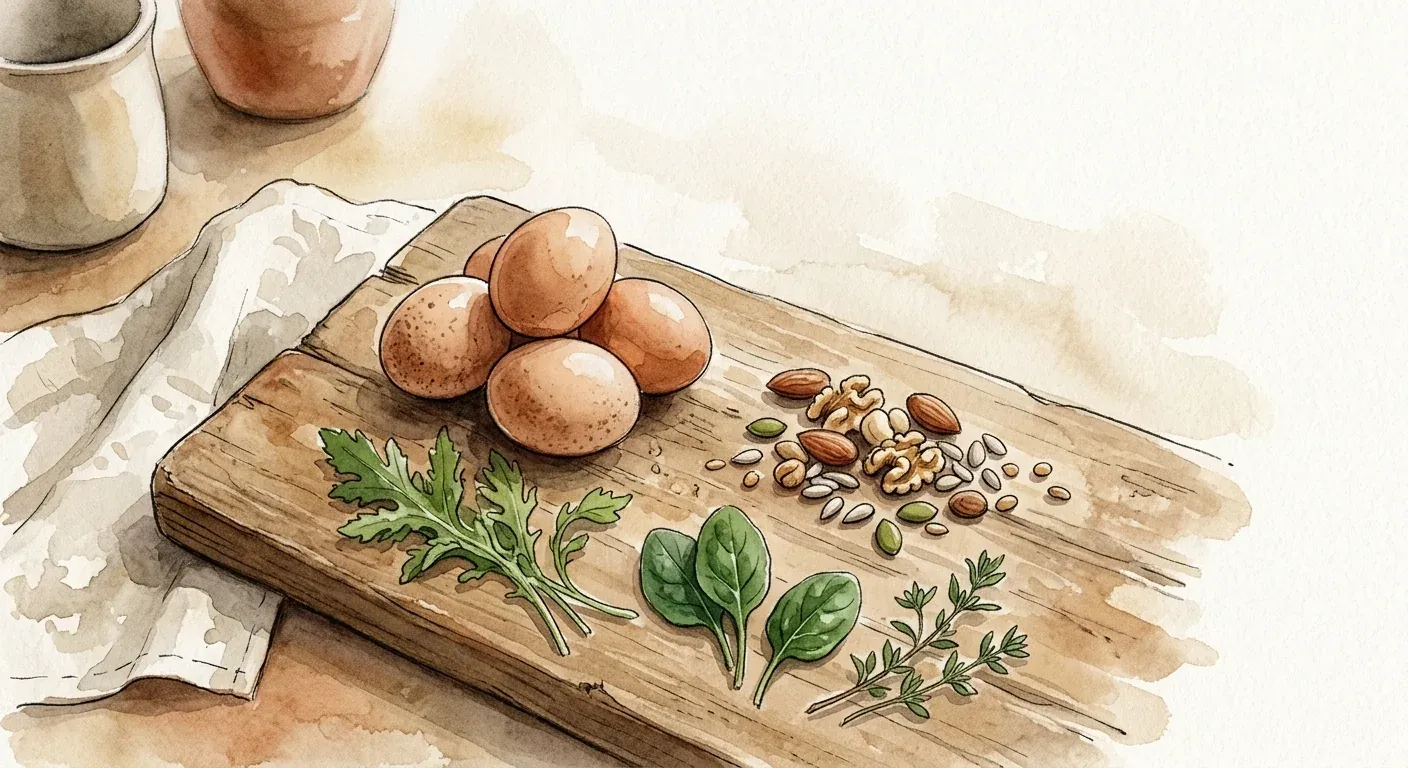
A normal varied diet supplies the ~30 mcg/day of biotin you need. Eggs, nuts, seeds, salmon, and vegetables cover it without a single gummy.
The honest bottom line: biotin is a real vitamin doing a real job, and for the rare person who is deficient, correcting it works. For everyone else — which is almost everyone reading this — a biotin supplement is a placebo with a lab-interference side effect. Spend the money on the blood panel instead.
What to read next
- Saw Palmetto for Hair Loss (2026) — a supplement with actual (if modest) RCT evidence, unlike biotin.
- Female Pattern Hair Loss Complete Guide (2026) — the full diagnostic blood panel for women with diffuse shedding.
- Minoxidil Complete Guide (2026) — the evidence-based first-line treatment if your shedding turns out to be androgenetic.
- The Hair Growth Cycle Explained (2026) — why telogen effluvium shedding looks alarming but usually self-resolves.
References
Disclaimer: This article summarizes published evidence and is not medical advice. If you take biotin in any amount, tell your physician before any blood test — the interference is real and clinically documented. If you are experiencing hair shedding, ask for a ferritin, TSH, and vitamin D panel rather than self-treating with supplements.