Rosemary Oil vs Minoxidil for Hair Loss (2026): What the One Real Trial Shows
📌 TL;DR
- The headline comes from one trial: Panahi 2015 found rosemary oil matched 2% minoxidil on hair count at 6 months, with significantly less scalp itching.
- The catch: it was compared to 2% minoxidil, not 5%. Men should be using 5%, which outperforms 2% by ~46%. 'As good as minoxidil' really means 'as good as the weaker minoxidil.'
- It's a single, non-placebo-controlled trial. Promising signal, not settled science. Rosemary oil is a reasonable adjunct or a fallback for minoxidil-intolerant users — not a first-line replacement for someone serious about androgenetic alopecia.
- Proposed mechanisms: improved scalp microcirculation, antioxidant/anti-inflammatory carnosic acid, and possible mild 5α-reductase inhibition (mostly animal and in-vitro data).
- Use it diluted — a few drops of rosemary essential oil per tablespoon of carrier oil, 2–3× weekly. Never apply the neat essential oil directly; it irritates skin.
Rosemary Oil vs Minoxidil for Hair Loss (2026): What the One Real Trial Shows
Last updated: May 2026 | Written by RK
Rosemary oil is the natural hair-loss remedy with an actual randomized trial behind it — which is rare, and is why it gets cited everywhere. The headline that spread online is “rosemary oil works as well as minoxidil.” That’s based on a real study, and the study is genuinely interesting. It’s also routinely quoted without the two caveats that change what it means.
This is the evidence-first entry next to the rest of the supplements series. It walks the one human trial honestly, the proposed mechanism, how to actually use rosemary oil, and where it fits — which is a real place, just not the place the headline implies.
Rosemary Oil for Androgenetic Alopecia
CLM-COND-androgenetic-alopecia-INT-rosemary-oil-001
Mechanism plausible + scattered human studies; "insufficient evidence".
- U.S. FDA — stance: neutral
"21 CFR Citation: 182.20 | Permitted Use: FLAVORING AGENT OR ADJUVANT | FEMA No.: 2992 | CAS Registry Number: 8000-25-7"
Source → - EFSA (EU) — stance: neutral
"1,548 claims on 'botanicals' have been placed on hold by the Commission pending further consideration on how to proceed with these"
Source → - NHS (UK) — stance: not_addressed
"Do not be taken in by claims for wonder products. There are no cures for female hair loss."
Source → - PubMed (NIH)
"Relative Efficacy of Conventional Monotherapies and Select Nonconventional, Over-the-Counter Products for Male Androgenetic Alopecia: A Network Meta-Analysis Study"
Source → - PubMed (NIH)
"Comparative Effect of Conventional and Non-Conventional Over-the-Counter Treatments for Male Androgenetic Alopecia: A Systematic Review and Network Meta-Analysis"
Source → - PubMed (NIH)
"Rosemary oil vs minoxidil 2% for the treatment of androgenetic alopecia: a randomized comparative trial"
Source → - PubMed (NIH)
"Rosmagain as a Natural Therapeutic for Hair Regrowth and Scalp Health: A Double-Blind, Randomized, Three-Armed, Placebo-Controlled Clinical Trial"
Source → - PubMed (NIH)
"Randomized trial of aromatherapy. Successful treatment for alopecia areata"
Source →
The trial everyone cites — Panahi 2015
The entire “rosemary = minoxidil” claim traces to a single study: Panahi et al. 2015, a randomized comparative trial published in SKINmed [1].
One randomized comparative trial — promising but not settledThe design:
That’s a real, encouraging result. Rosemary oil matched an FDA-approved drug on the primary outcome and beat it on tolerability. But two caveats decide what the trial actually licenses you to claim.
Caveat 1: it was 2% minoxidil, not 5%
The trial used 2% minoxidil. For men, 5% is the rational default — Olsen’s 2002 trial showed 5% delivers roughly 46% more hair count gain than 2%. “As good as minoxidil” in this study specifically means “as good as the weaker minoxidil men shouldn’t be starting on anyway.” Against 5%, rosemary oil has never been tested.
Caveat 2: one trial, no placebo arm
This is a single study, from a single center, and it was a head-to-head of two active treatments with no placebo group. Both arms improved — but without a placebo arm, the trial can’t fully separate the treatments’ effect from regression to the mean or measurement effects. It’s a promising signal that deserves a bigger, placebo-controlled replication. That replication hasn’t happened.
The honest one-liner: rosemary oil matched the weaker minoxidil in one un-replicated trial. That’s a real reason to take it seriously — and not a reason to drop evidence-based treatment for it.
How rosemary oil might actually work
The mechanism is less established than the Panahi result, but three plausible pathways have animal and in-vitro support:
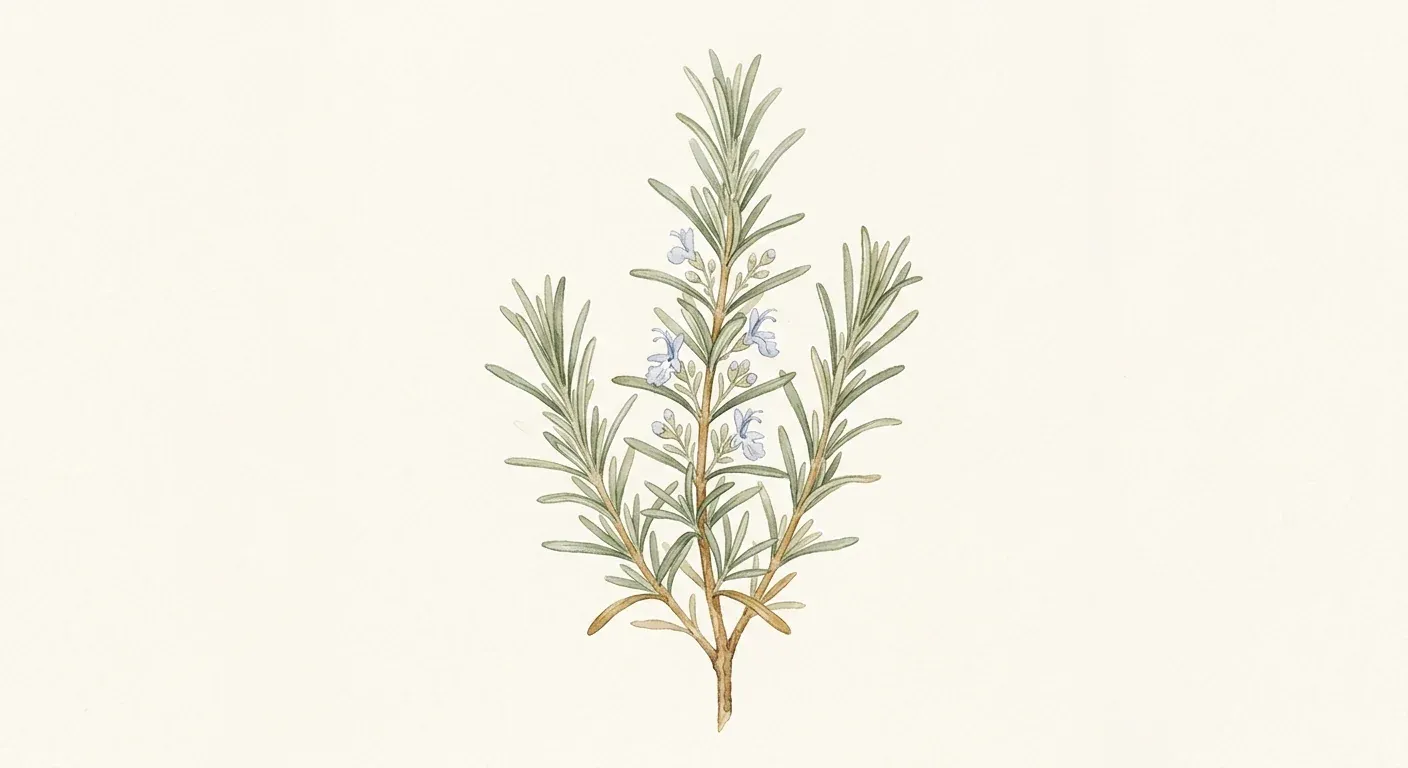
Rosemary (Rosmarinus officinalis). The carnosic and rosmarinic acids behind its proposed effects are concentrated in the leaves.
The Murata 2013 mouse study is the most-cited mechanistic paper: rosemary leaf extract promoted hair regrowth in mice and showed 5α-reductase inhibition in their assays [2]. That’s mechanistically encouraging — 5α-reductase is the same enzyme finasteride blocks — but mouse hair-growth models translate to humans inconsistently, so it’s supporting evidence, not proof.
Worth noting historically: the 1998 Hay aromatherapy trial for alopecia areata used a blend of essential oils that included rosemary (alongside thyme, lavender, and cedarwood) and showed benefit [3]. That trial is about a different condition (autoimmune patchy loss, not AGA) and a blend, not rosemary alone — but it’s part of why rosemary kept getting studied.
How to actually use rosemary oil
The single most important rule: dilute it.
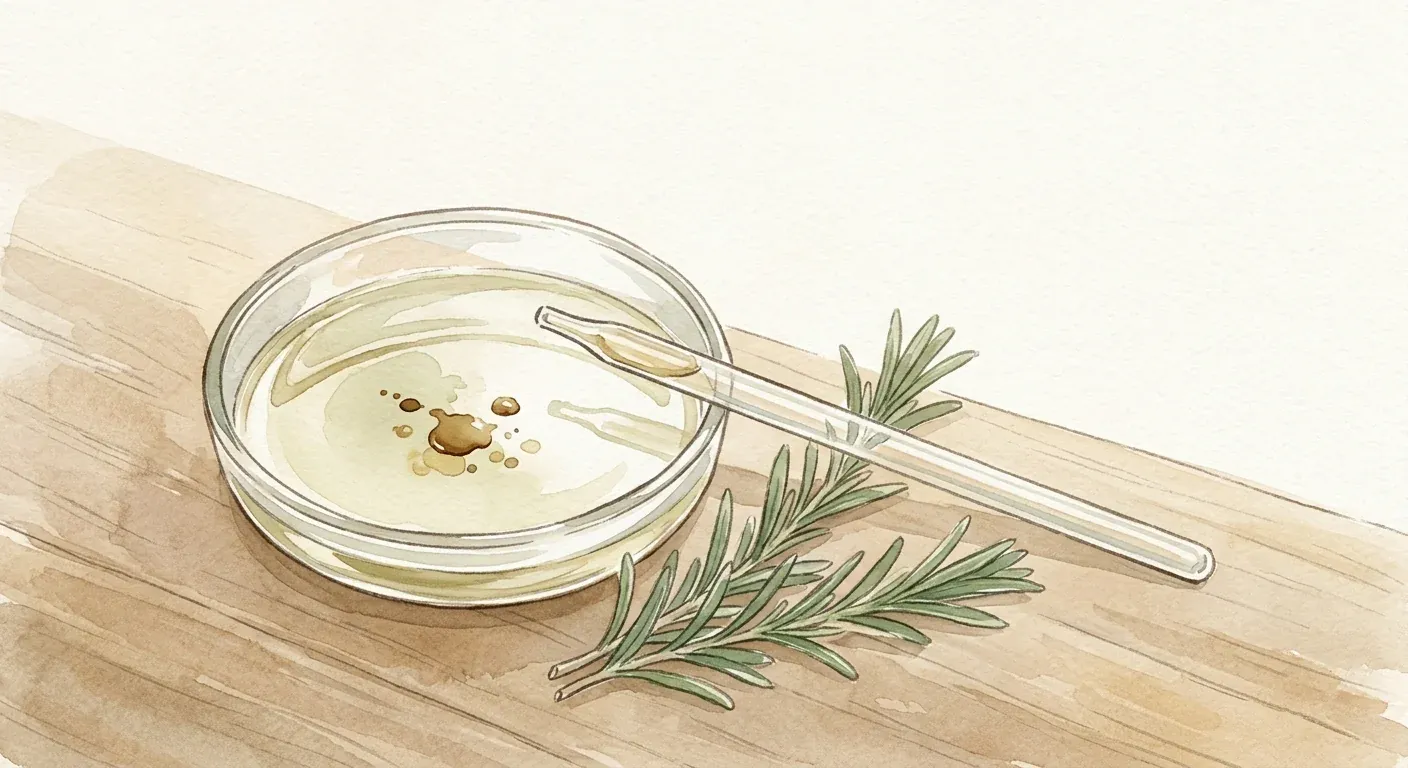
Rosemary essential oil is potent. Neat application irritates and burns. A few drops per tablespoon of carrier oil is the working ratio.
1 Mix about 5 drops of rosemary essential oil per tablespoon of carrier oil (jojoba or coconut are common, well-tolerated choices).
2 Massage into the scalp — the thinning areas specifically — for 1–2 minutes. The massage itself may contribute via mechanical stimulation.
3 Leave for at least 10 minutes — or overnight with a towel on the pillow — then wash out with a mild shampoo.
4 Repeat 2–3 times per week. Patch-test on your forearm first if you have sensitive skin.
5 Give it 6 months before judging. The Panahi trial showed nothing at month 3 — the result was a month-6 finding.
A rosemary-infused water rinse (steeping fresh or dried rosemary, then rinsing the scalp) is a gentler option, but it delivers far less active compound than diluted essential oil and has no trial support. The diluted essential oil is what the evidence — such as it is — points to.
Where to find it
Rosemary essential oil is sold by every essential-oil brand, in pharmacies, health stores, and online (Amazon, iHerb). Look for 100% pure Rosmarinus officinalis essential oil with no fragrance additives, ideally steam-distilled. A small bottle costs a few dollars and lasts months at the dilution above. Pre-blended “rosemary hair oils” exist too — check that rosemary is high on the ingredient list and not just a token amount behind a long list of carrier oils and fragrance.
Who should NOT rely on rosemary oil
Moderate-to-fast AGA in a man who wants the best odds
If you’re progressing and serious about it, 5% minoxidil plus a DHT blocker is the evidence-backed move. Rosemary oil belongs on top of that, not instead of it.
Pregnant or breastfeeding
Rosemary essential oil is generally advised against in pregnancy. Talk to your OB before using any essential oil topically while pregnant or nursing.
Sensitive or reactive skin without a patch test
Even diluted, essential oils can trigger contact dermatitis. Patch-test on the inner forearm for 24 hours before the first scalp application.
So where does rosemary oil fit?
- • Tolerability was its clearest win over minoxidil
- • Matched 2% minoxidil on hair count
- • Low risk, low cost
- • One real RCT, more than most natural remedies have
- • Set expectations: tested vs 2%, not 5%
- • Give it a full 6 months
- • 5% minoxidil + a DHT blocker is the evidence base
- • Rosemary oil layers on top without conflict
- • Its anti-inflammatory effect may ease minoxidil irritation
Rosemary oil is the rare natural remedy that earned its reputation with an actual trial rather than testimonials. That trial is real and worth respecting. It’s also one un-replicated study against the weaker minoxidil — so the honest position is enthusiasm with boundaries. Use it where it fits: as a gentler option for the minoxidil-intolerant, as the best-evidenced choice for the pharma-averse, or as a low-risk adjunct. Just don’t let the headline talk you out of treatment that has decades of data behind it.
What to read next
- Minoxidil Complete Guide (2026) — why 5% is the default for men, and what rosemary oil was actually (and wasn’t) compared against.
- Saw Palmetto for Hair Loss (2026) — the natural DHT blocker, a sensible companion to a rosemary-oil routine.
- Minoxidil Side Effects (2026) — if scalp itching is your problem, this explains the propylene glycol cause and the foam fix.
- Biotin for Hair Loss: The Myth (2026) — for contrast: a popular supplement that, unlike rosemary oil, has no trial support at all.
- Minoxidil for Hair Loss: The Complete Guide (2026) — the drug rosemary oil was tested head-to-head against.
- Scalp Massage for Hair Loss (2026) — another low-risk topical adjunct, with the rosemary-oil application as a natural pairing.
- Best Hair Loss Treatments (2026) — where rosemary oil sits against the evidence-based options.
References
Disclaimer: This article summarizes published evidence and is not medical advice. Rosemary essential oil must be diluted in a carrier oil before scalp use; never apply it neat. Patch-test before first use, avoid during pregnancy and breastfeeding, and treat the single supporting trial for what it is — a promising, un-replicated study against 2% minoxidil. If your hair loss is moderate or progressing, see a dermatologist about evidence-based treatment rather than relying on rosemary oil alone.