Saw Palmetto for Hair Loss in 2026: Does It Actually Work?
📌 TL;DR
- Saw palmetto inhibits 5α-reductase (the same enzyme finasteride targets) but with broader Type I + II coverage.
- Head-to-head vs finasteride at 24 months: 38% regrew hair on saw palmetto vs 68% on finasteride (Rossi 2012).
- Side-effect rate matches placebo. No measurable hit to libido or erectile function in the trial data.
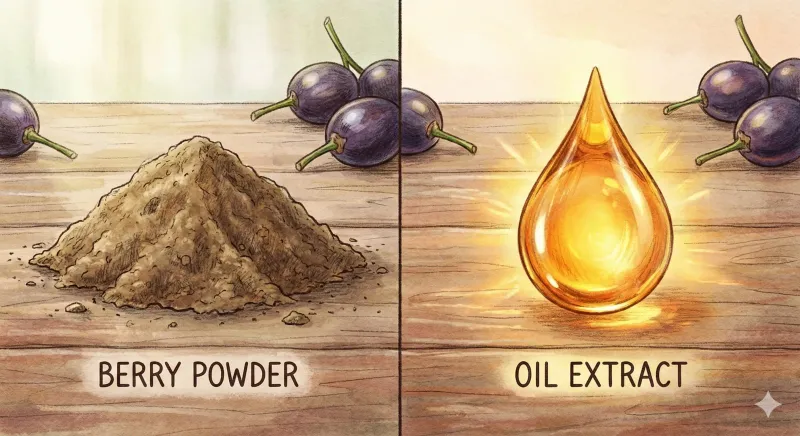
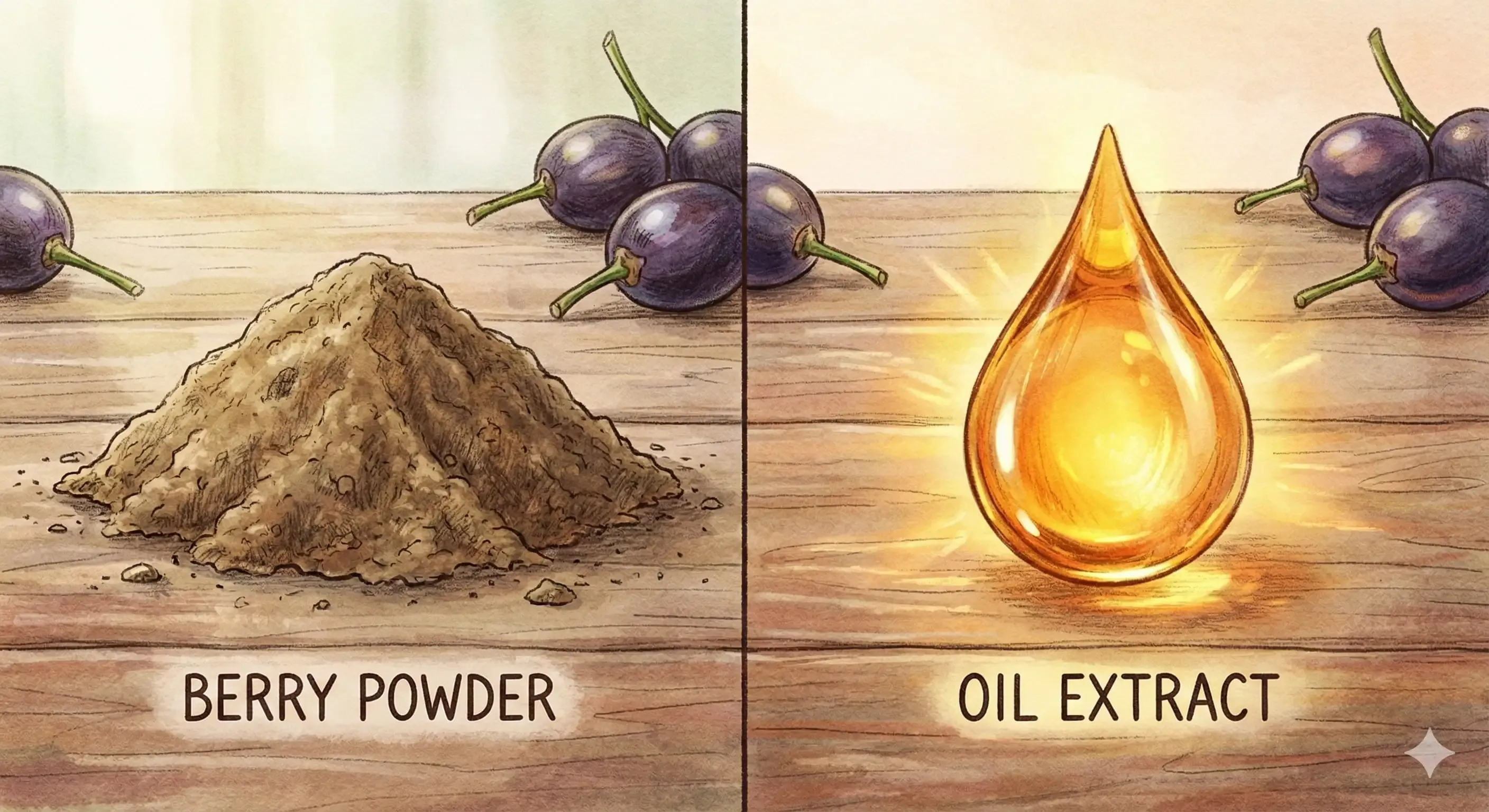
- USA vs Europe paradox: dried powder = barely works, supercritical CO2 oil extract (85–95% fatty acids) = real effect.
- Effective dose: 160–320 mg/day of standardized extract. Minimum 3–6 months to evaluate.
Saw Palmetto for Hair Loss in 2026: Does It Actually Work?
Last updated: May 2026 | Written by RK
If you’ve spent any time on r/tressless or hair-loss forums, you’ve seen the question that gets asked roughly once a week:
“I don’t want to take finasteride. Does saw palmetto actually work?”
The answer depends on which country’s research you read. US trials are mostly negative. European trials are consistently positive. Same molecule, contradictory headlines. I spent four months reading the trial data instead of the marketing copy, and the contradiction has a clean explanation that almost no one online surfaces clearly. Here’s the version with the receipts.
Multi-source evidence verdict
Before the deep dive, here’s the independent verdict from 14 parallel sub-agents reviewing every English-language authority (FDA, EFSA, NHS, WHO, NIH ODS, Mayo, Cleveland, Harvard, AAD, PubMed). The system grades saw palmetto for androgenetic alopecia as B — Preliminary Evidence (with caveats) — real RCT data exists, but NOT a finasteride/minoxidil replacement:
Saw Palmetto for Androgenetic Alopecia
CLM-COND-androgenetic-alopecia-INT-saw-palmetto-001
Small RCT base, direction consistent but samples small; "may consider".
- NIH Office of Dietary Supplements — stance: cautious
"saw palmetto is probably not helpful for urinary tract symptoms associated with prostate enlargement in men. The evidence is too limited to allow conclusions to be reached [for male-pattern hair loss]. Serenoa repens, at two and three times…"
Source → - U.S. FDA — stance: cautious
"Saw palmetto is not the subject of an applicable USP or NF monograph, is not a component of an FDA-approved human drug, and does not appear on the 503A bulks list."
Source → - EFSA (EU) — stance: neutral
"1,548 claims on 'botanicals' have been placed on hold by the Commission pending further consideration on how to proceed with these"
Source → - NHS (UK) — stance: against
"Your doctor should not offer you homeopathy, herbal treatments or acupuncture to treat urinary symptoms ... there is not enough reliable evidence about how well they work or how safe they are. ... [Saw palmetto] was no more effective than a…"
Source → - WHO — stance: neutral
"WHO monographs on selected medicinal plants - Volume 2"
Source → - PubMed (NIH)
"A randomized, double-blind, placebo-controlled trial to determine the effectiveness of botanically derived inhibitors of 5-alpha-reductase in the treatment of androgenetic alopecia"
Source → - PubMed (NIH)
"Comparitive effectiveness of finasteride vs Serenoa repens in male androgenetic alopecia: a two-year study"
Source →
The rest of this article unpacks the mechanism, the trial data, the USA-vs-Europe paradox, and how to actually buy a working product.
What saw palmetto actually is
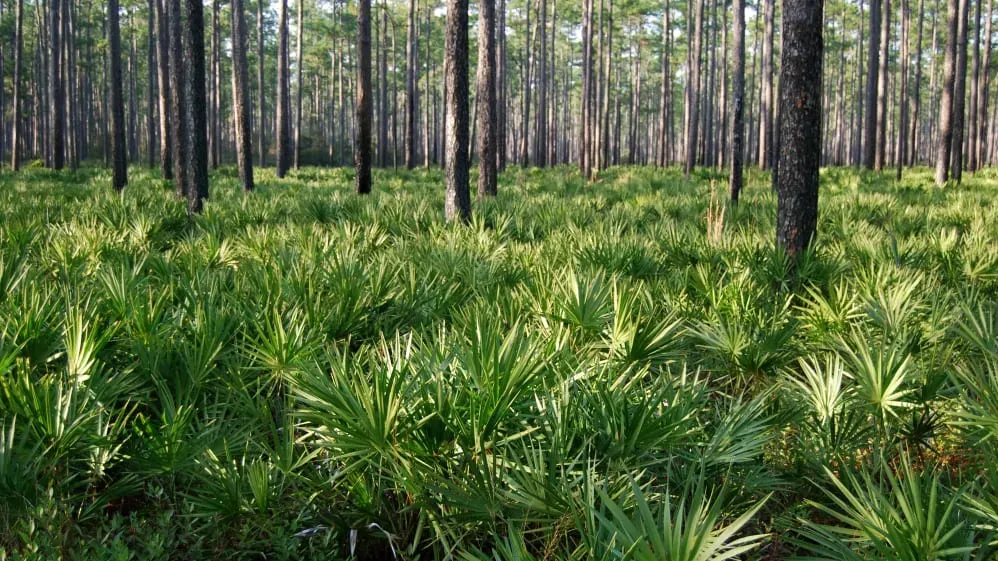
Saw palmetto (Serenoa repens) is a small palm native to the southeastern US. The medical interest is in its berries, which contain a profile of fatty acids and phytosterols that interfere with androgen metabolism.
Three things you should know:
- It was originally a prostate drug, not a hair drug. Finasteride and saw palmetto were both developed for benign prostatic hyperplasia (BPH). The “hair grew back” effect was a side observation that turned into a separate use case [1].
- It’s the most-studied botanical for AGA. Most “natural hair loss supplements” have weak or no evidence. Saw palmetto has multiple double-blind RCTs.
- It’s mechanism-aligned with finasteride — same target, less aggressive. That’s both its appeal and its limit.
How it works on the follicle
Androgenetic alopecia is driven by DHT (dihydrotestosterone) attacking the hair follicle. DHT is made by the enzyme 5α-reductase converting testosterone in scalp tissue. Block the enzyme → less DHT → follicles stop miniaturizing.
Finasteride blocks Type II 5α-reductase. Saw palmetto’s fatty acids — particularly lauric, oleic, and myristic acid — appear to do three things [2][3]:
Dual inhibition
Blocks both Type I and Type II 5α-reductase. Finasteride hits mostly Type II.
Receptor competition
Some compounds also block DHT from binding to the androgen receptor on the follicle.
Anti-inflammatory
Reduces follicular micro-inflammation — particularly relevant for oily, irritated scalps.
The dual-inhibition piece is what I find most interesting. In theory it gives saw palmetto a wider mechanism than finasteride. In practice, the lower potency means total DHT suppression is still less than what finasteride achieves. Wider coverage at lower force. For stacking strategies, see our best hair loss treatments overview — saw palmetto is often combined with minoxidil for synergistic effects.
What the trials actually show
The most quoted trial is Rossi et al. 2012, comparing 320 mg/day saw palmetto extract to 1 mg/day finasteride in 100 men with mild-to-moderate AGA over 24 months [4]:
One caveat worth flagging on Rossi 2012: the trial was open-label (neither patients nor researchers were blinded — verified against PubMed PMID 23298508), not single-blind or double-blind, and limited to 100 men. Open-label is the weakest RCT design and is vulnerable to placebo and observer bias. The Evron 2020 systematic review specifically notes that saw palmetto’s evidence base is smaller and methodologically weaker than finasteride’s [5]. The directional finding — that saw palmetto produces meaningful effect — is consistent across the literature. The exact magnitude (38% regrowth) should be read as approximate, not precise.
Newer evidence: VISPO 2023 (16-week RCT)
A more recent placebo-controlled trial (Sudeep et al. 2023, n=80) tested a standardized saw palmetto oil extract called VISPO — both oral and topical — over 16 weeks [6]. Unlike most earlier studies, this one used phototrichogram measurements at 8 and 16 weeks plus serum DHT/5α-reductase markers.
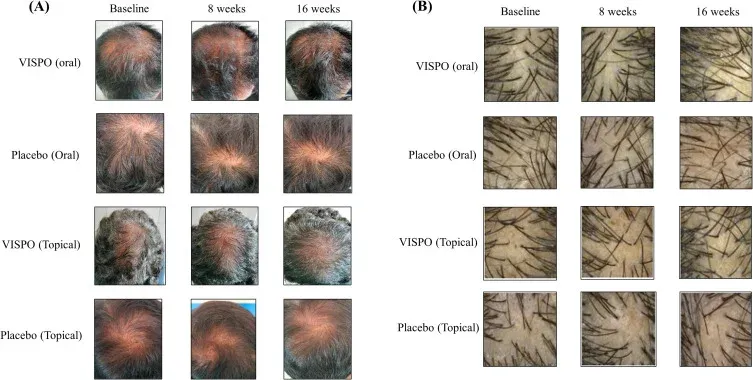
Figure 4 from Sudeep et al. 2023 — vertex scalp at baseline vs week 16 with paired phototrichogram. Used under CC-BY-NC 3.0.
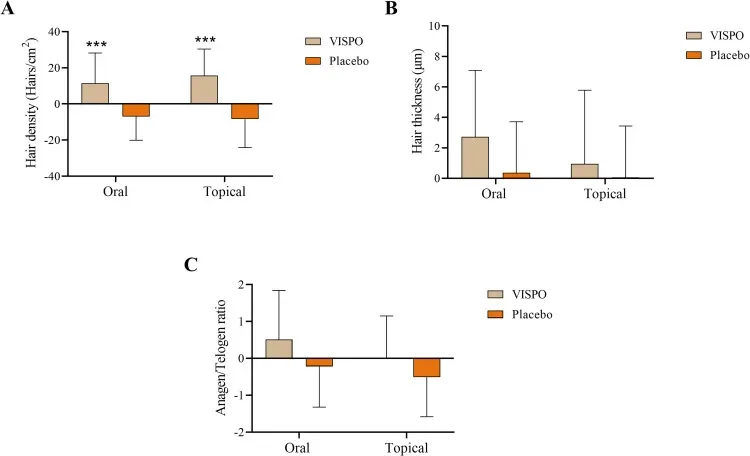
Figure 3 from Sudeep et al. 2023 — density, thickness, and anagen/telogen ratio over 16 weeks (density and thickness reached significance; the anagen/telogen ratio trend did not). Used under CC-BY-NC 3.0.
Headline outcomes from VISPO 2023:
- Hair density increased significantly vs placebo — +5.17% with the oral arm and +7.61% with the topical arm (p<0.001)
- Anagen-to-telogen ratio trended in the right direction but did not reach statistical significance
- Serum 5α-reductase and DHT both dropped on the oral arm (p<0.001)
- Topical-only also produced effect, though smaller than oral
This is the strongest single-paper evidence published to date. It doesn’t replace Rossi 2012 as the head-to-head benchmark, but it adds mechanistic confirmation: saw palmetto really is dropping serum DHT, not just exerting placebo effect on perception.
What this means: If your loss is mild and creeping, saw palmetto plus minoxidil can plausibly hold the line. If you’re already at Norwood 3 or 4 (visible recession past the temples and noticeable thinning at the crown) and progressing fast, the math probably favors finasteride — even with the side-effect risk, because the gap in efficacy widens as severity increases.
The USA-vs-Europe paradox
Here’s where most internet writeups get it wrong.
If you Google “does saw palmetto work for hair loss,” you’ll find half the articles say “studies show no effect” and half say “European doctors prescribe it routinely.” Both are true. The same molecule. Different products.
“Same as placebo”
NIH-funded BPH trials (STEP, CAMUS) used dried whole-berry powder. Mostly null results.
“Comparable to finasteride”
French doctors prescribe Permixon (a CO2-extracted standardized oil) as a regulated drug.
The difference is extraction method, which determines how much of the active fatty acid content makes it into the capsule:
- Dried powder of the berry: ~10–15% fatty acids by weight. Cheap. Not biologically meaningful at normal doses.
- Supercritical CO2 oil extract: 85–95% standardized fatty acids. More expensive. This is what the positive trials use.
This is why dose alone is a misleading metric. A “1,000 mg powder” capsule may contain less active compound than a “320 mg standardized softgel.”
How to choose a product (the only section that matters at the store)
There are roughly four ways saw palmetto shows up on shelves. Only the first one is worth your money for AGA.
Label-reading checklist
Before you put a bottle in your cart, the label should tell you:
1 “Supercritical CO2 extract” OR “standardized to 85–95% fatty acids and sterols”
2 Specific milligram dose per capsule (160 mg or 320 mg are the trial-tested amounts)
3 Softgel form (oil-based) — not hard capsule with brown powder
4 Third-party tested (USP, NSF, or ConsumerLab) — bonus, not required
If a bottle just says “saw palmetto 1000 mg” with no extraction or fatty-acid spec, assume it’s powder. Skip it.
Where to find these supplements
Standardized saw palmetto softgels are easy to find at most US pharmacies (CVS, Walgreens), Costco, and online via Amazon, iHerb, and brand websites. The brands most commonly used in trials and recommended by dermatologists who include the supplement in their protocols include Now Foods (CO2-extracted), Solaray, and Swanson — all in the $8–15/month range for the standardized softgel format.
For the patented extract route, look for products labeled “USPlus” (US-developed standardized extract used in 2025 RCTs) or “Permixon” (the European pharmaceutical-grade version, harder to obtain in the US without a prescription).
Dosage and timing protocol
Based on the trial data, the practical protocol is:
Dose 160 mg, twice daily (320 mg/day total) of standardized extract
Timing With meals — fatty acids absorb better with dietary fat
Trial length 3 months minimum, 6 months for fair evaluation
Tracking Photo same scalp angle, same lighting, every 90 days
Stack Pairs well with topical minoxidil (different mechanism)
A common Reddit-tier mistake: taking saw palmetto for 6 weeks, seeing nothing dramatic, and quitting. The hair growth cycle is on the order of months, not weeks. The first thing you’ll notice — if it’s working — is that shedding slows down. Regrowth is the second-order effect that takes longer.
Who should NOT take saw palmetto
❌ Pregnant or breastfeeding
Theoretical risk of disrupting fetal androgen development. Hard rule, no exceptions.
❌ Trying to conceive (men)
5α-reductase inhibition can transiently lower DHT-dependent semen parameters. Not a permanent issue, but worth pausing during active conception attempts.
⚠️ On blood thinners or scheduled for surgery
Saw palmetto has mild antiplatelet activity. Stop at least 2 weeks before any surgery. If you’re on warfarin or DOACs, talk to your prescriber first.
⚠️ On finasteride or dutasteride already
Adding saw palmetto on top of finasteride mostly stacks side-effect risk without proportional benefit, since the enzyme is already heavily blocked. Pick one.
The decision card
Best for: mild AGA, finasteride-averse
Norwood 1–2, recent onset, side-effect risk-averse. Saw palmetto + minoxidil is a defensible starting protocol.
Marginal for: moderate AGA, on the fence about finasteride
Norwood 3+. Worth a 6-month trial, but understand the lower ceiling. If you don’t see meaningful stabilization at 6 months, the stronger drug is the rational next step.
Not the right tool: aggressive AGA, fast progression
Norwood 4+, visible loss in <12 months. Saw palmetto’s lower potency probably won’t keep up. Talk to a dermatologist about finasteride/dutasteride.
What to read next
- Minoxidil for Hair Loss: The Complete Guide (2026) — saw palmetto pairs cleanly with topical minoxidil. Different mechanism, complementary effect.
- Rogaine vs Kirkland Minoxidil (2026) — once you’ve decided on minoxidil, this breaks down which brand and form to actually buy.
References
[6] Sudeep HV, et al. “Oral and topical administration of a standardized saw palmetto oil reduces hair fall and improves the hair growth in androgenetic alopecia subjects: a 16-week randomized, placebo-controlled study.” Clin Cosmet Investig Dermatol. 2023;16:3251-3266. — figures 3 and 4 reproduced in this article under CC-BY-NC 3.0.
Disclaimer: This article is personal research and review. It is not medical advice. Saw palmetto is a 5α-reductase inhibitor and shares mechanism with finasteride. Before starting it — especially if you’re on hormonal medication, blood thinners, planning a pregnancy, or have a hormone-sensitive condition — consult a licensed physician or dermatologist.