Tocotrienols for Hair Loss: One RCT, 34.5% Hair Count Increase, and the Honest Caveats (2026)
📌 TL;DR
- One direct human RCT exists: Beoy et al. 2010 (n=38, 21 treatment / 17 placebo). 100 mg/day mixed tocotrienols for 8 months produced a 34.5% mean increase in hair count vs a 0.1% decrease in placebo.
- The 2025 Frontiers in Nutrition network meta-analysis (19 RCTs, 1,658 AGA patients) re-confirmed tocotrienols significantly improved hair density: SMD 0.86 hairs/cm² (95% CI 0.16–1.56). SUCRA ranking 74.1%, 3rd among supplements analysed.
- Mechanism: tocotrienols reduce oxidative stress in the scalp (lipid peroxidation rises in balding scalp tissue). A 2017 mechanistic study also implicates an E-cadherin / β-catenin pathway in follicle activation.
- Tocotrienols are not the same as the tocopherol-form vitamin E in most multivitamins. Different molecule, ~40–60× more bioactive in lipid membranes.
- Position: a reasonable second-tier add-on after saw palmetto + pumpkin seed oil. The evidence base is thinner than PSO's (1 trial vs 1 trial of similar n, but PSO has 5α-reductase mechanism, tocotrienols has antioxidant mechanism).
- Effective dose: 100 mg/day mixed tocotrienols (the Beoy 2010 protocol). Look for products with the EVNol SupraBio or Tocomin brand (palm-derived, what was used in mechanistic follow-up). Cost: ~$15–25/month.
Tocotrienols for Hair Loss: One RCT, 34.5% Hair Count Increase, and the Honest Caveats (2026)
Last updated: May 2026 | Written by RK
In the supplement world, “tocotrienols” mostly shows up on cardiovascular and liver-support labels — it’s the lesser-known half of the vitamin E family, more bioactive than the alpha-tocopherol everyone takes. But there’s exactly one human trial showing it might also grow hair, and the result was striking enough that it’s been cited in nearly every “natural hair loss” article since: 34.5% increase in hair count over 8 months versus 0.1% decrease in placebo.
That’s a real number from a real RCT. It’s also one trial with 38 people. This article walks through what the data actually says, what the 2025 meta-analysis added, the mechanism, and where tocotrienols realistically fit in a hair-loss stack.
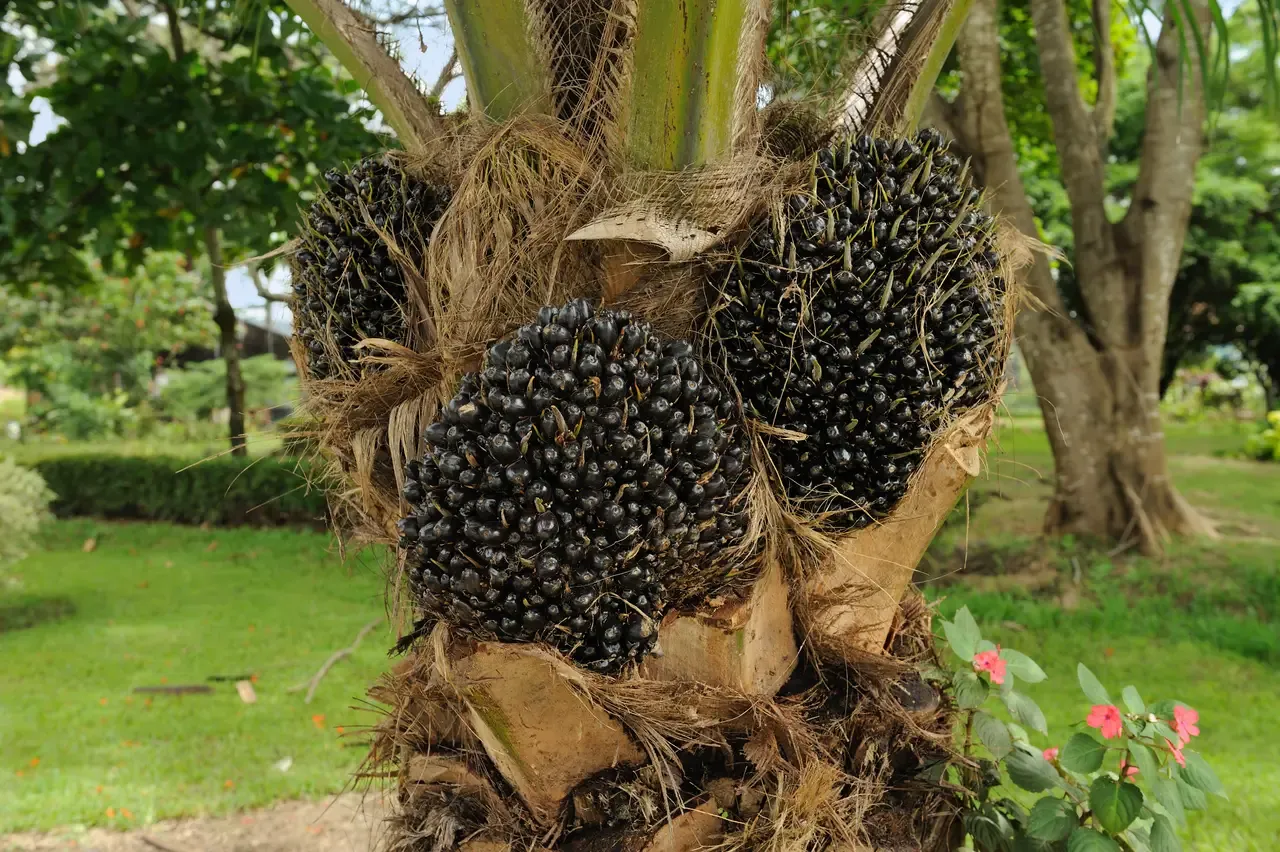
Photo: Cayambe via Wikimedia Commons (CC BY-SA 3.0). Oil palm fruit at the Portoviejo botanical garden, Ecuador.
TL;DR
- One direct human trial: Beoy 2010, n=38, 100 mg/day mixed tocotrienols for 8 months. Treatment +34.5% hair count, placebo -0.1%.
- 2025 Frontiers meta-analysis: 19 RCTs, 1,658 AGA patients. Tocotrienols SMD 0.86 hairs/cm² (95% CI 0.16–1.56), ranked 3rd among supplements (SUCRA 74.1%).
- Mechanism: antioxidant — reduces lipid peroxidation in scalp tissue. Plus a 2017 E-cadherin / β-catenin pathway finding.
- Dose to replicate: 100 mg/day mixed tocotrienols (palm-derived preferred), 6+ months.
- Position in stack: second-tier add-on after saw palmetto + pumpkin seed oil. Not a finasteride/minoxidil replacement.
- Cost: roughly $15–25/month.
What tocotrienols actually are (and why they’re not the vitamin E in your multivitamin)
Vitamin E is a family of eight fat-soluble compounds, not a single molecule:
- Tocopherols (4 isomers: alpha, beta, gamma, delta) — the form in most multivitamins, almonds, sunflower oil
- Tocotrienols (4 isomers: alpha, beta, gamma, delta) — the form in palm oil, rice bran oil, annatto
Both share a chromanol head, but tocotrienols have an unsaturated tail (three double bonds) where tocopherols have a saturated phytyl tail. That structural difference matters more than it sounds.

Tocotrienol structures by Calvero (Public Domain). The isoprenoid tail with three double bonds is what distinguishes tocotrienols from saturated-tail tocopherols.
The unsaturated tail makes tocotrienols:
- Faster at penetrating lipid membranes — they slot into the lipid bilayer more efficiently than tocopherols, which sit at membrane surfaces
- Stronger free-radical scavengers in lipid environments — orders of magnitude more bioactive in some assays (the often-quoted 40–60× figure is from in-vitro lipid peroxidation work — real-world clinical advantage is more modest)
- More tissue-selective — tocotrienols concentrate in adipose tissue, skin, scalp, and liver
If you’re already taking a multivitamin with “vitamin E”, you’re getting alpha-tocopherol. That’s a different molecule. To get tocotrienols, you need a product specifically labelled as such — usually palm-derived mixed tocotrienols (Tocomin, EVNol SupraBio brands) or rice-bran-derived.
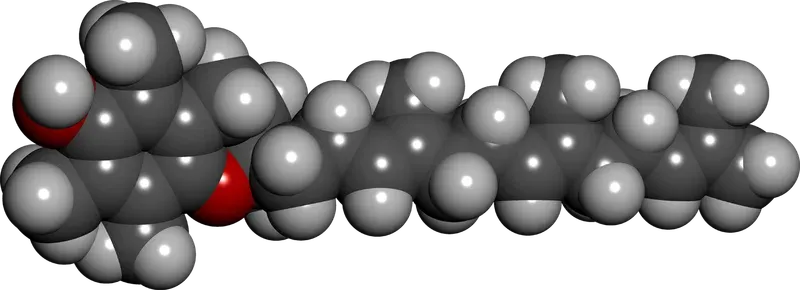
Alpha-tocotrienol 3D model by SubDural12 (Public Domain). The kink in the tail comes from the three double bonds — tocopherols have a straight saturated tail.
The Beoy 2010 trial in detail
This is the only direct human hair-count RCT on tocotrienols. It was published in Tropical Life Sciences Research, a peer-reviewed Malaysian journal — not a top-tier dermatology venue, which is part of why it stayed under the radar of mainstream hair clinics for years.
Design:
- 38 volunteers with hair loss (men and women, no Norwood stage specified in the abstract)
- 21 randomised to oral tocotrienol (100 mg/day mixed tocotrienols, palm-source)
- 17 randomised to placebo
- Outcome: hair count in a fixed scalp area; weight of 20 strands of 1 cm hair clippings
- Duration: 8 months, with measurements at baseline, 4 months, and 8 months
Results:
| Outcome | Tocotrienol group | Placebo group |
|---|---|---|
| Hair count change at 8 months | +34.5% | -0.1% |
| Hair weight change | No significant difference | No significant difference |
The hair count result is what gets cited. The hair weight (a proxy for shaft thickness) showed no significant change in either group, which is a quieter detail — pure miniaturisation reversal would also raise weight. Single small RCT
Strengths:
- Randomised and placebo-controlled
- Long enough duration (8 months) to capture the anagen-induction phase
- Real outcome measure (hair count in a defined area, not subjective)
Honest weaknesses:
- Small sample size (n=38)
- Only one trial — no independent replication as a standalone study in the 15+ years since
- Not specifically AGA — “volunteers with hair loss” could include other patterns (telogen effluvium, alopecia areata)
- Not a top-tier journal (lower citation visibility likely contributed to the lack of replication)
- No statement on Norwood/Ludwig grading at enrolment
The headline number is real. The confidence we should have in it is “one good signal, awaiting confirmation.”
What the 2025 meta-analysis added
The Wang et al. network meta-analysis published in Frontiers in Nutrition (2025) pooled 19 RCTs covering 1,658 AGA patients across many supplement classes (Nutrafol, AMSbzs, isoflavones, marine protein, tocotrienols, etc.). Beoy 2010 was the lone tocotrienol arm.
For tocotrienols specifically:
- Effect on hair density: SMD 0.86 hairs/cm² (95% CI 0.16–1.56) versus placebo
- SUCRA (Surface Under the Cumulative Ranking) ranking: 74.1% — 3rd place among supplements analysed for hair density
- Statistically significant — the lower bound of the confidence interval (0.16) doesn’t cross zero
What this means in plain English: when the meta-analysis pooled data and ranked supplements, tocotrienols came out as one of the top performers — but the ranking is driven by a single small trial. The wide confidence interval (0.16 to 1.56) reflects that uncertainty. A real-world person taking tocotrienols might get a substantial benefit, or might get a barely-detectable benefit, and current evidence can’t distinguish.
This is a more nuanced position than either “tocotrienols don’t work” (they probably do, by the data we have) or “tocotrienols are a miracle” (the data is one trial — calm down).
Mechanism: oxidative stress and the β-catenin finding
Why would tocotrienols affect hair growth at all? Two mechanistic threads:
Antioxidant action. Balding scalp tissue shows elevated lipid peroxidation and reduced antioxidant capacity compared to non-balding scalp. The hypothesis: oxidative damage to the dermal papilla and bulge stem cells contributes to follicle dysfunction. Tocotrienols, with their high lipid-membrane penetration, would plausibly reduce that damage — particularly relevant in the lipid-rich environment of the scalp follicle.
The E-cadherin / β-catenin pathway. A 2017 study from Ohio State (Ahmed et al., using a tocotrienol-rich palm complex) reported that tocotrienols accelerate anagen hair cycling in mice via suppression of epidermal E-cadherin, which triggers a roughly four-fold induction of β-catenin and its nuclear translocation [4]. β-catenin is a known anagen-induction signal — part of the same Wnt pathway that drives the hair cycle in mouse models. This is mechanistic-only work (mouse skin, not a human trial), but it gave the 2010 clinical finding a more specific molecular basis than just “antioxidant”.
Importantly: none of this targets DHT. Tocotrienols don’t inhibit 5α-reductase (unlike saw palmetto, pygeum, or finasteride). They work on a different axis — oxidative stress and follicle activation — which is why they’re complementary to DHT-blocking supplements rather than redundant with them.
Cost calculation
Working out cost-per-day for the Beoy 2010 protocol:
- Target: 100 mg/day mixed tocotrienols
- Common product strengths: 50 mg/cap (typical) or 75 mg/cap (some brands)
- Daily dose: 2× 50 mg or 1.3× 75 mg
| Source | Per-bottle cost | Per-day cost (100 mg) | Monthly |
|---|---|---|---|
| Generic palm-source mixed T3 (Amazon, 60ct × 50mg) | ~$15 | $0.50 | ~$15 |
| EVNol SupraBio (Tocomin brand, 60ct × 50mg) | ~$22 | $0.73 | ~$22 |
| Annatto-source delta-T3 only (specialised) | ~$30 | $1.00 | ~$30 |
| Rice-bran tocotrienol complex | ~$18 | $0.60 | ~$18 |
For comparison, in our pumpkin seed oil article the trial dose ran around $20/month, and in our saw palmetto article the standardised extract ran $15–25/month. So tocotrienols are in the same ballpark — not the cheapest add-on, not the most expensive.
If you’re going to spend money on this, palm-source mixed tocotrienols is the closest analogue to what was tested. Annatto-derived delta-only products are more fashionable (and pricier) but the trial wasn’t done with them.
Where tocotrienols fit in a hair-loss stack
The honest hierarchy of supplements for AGA, by evidence weight:
- Saw palmetto — Wessagowit 2016, Rossi 2012 (open-label), Prager 2002. ~10× the trial volume of tocotrienols. Targets DHT directly.
- Pumpkin seed oil — Cho 2014 RCT (n=76). One good trial, similar evidence weight to tocotrienols. Targets DHT-related pathway.
- Tocotrienols — Beoy 2010 RCT (n=38). One trial. Antioxidant mechanism, complementary to DHT blockers.
- Pygeum — strong BPH evidence, weak standalone AGA evidence. Combo-trial only (see pygeum article).
- Rosemary oil, GHK-Cu, biotin, etc. — varying evidence quality, separate pages.
A reasonable stack progression:
- Just starting: saw palmetto 320 mg/day, give 6 months
- Stack expansion: add pumpkin seed oil 400 mg/day
- Round out the antioxidant axis: add tocotrienols 100 mg/day
- Maximum no-Rx: add pygeum 100 mg/day
Each addition has diminishing marginal evidence. By tocotrienols, you’re at supplement #3 with one trial behind it. That’s still defensible — the trial was real, the meta-analysis confirmed significance — but expectations should scale with the evidence base.
What this won’t fix on its own
- Aggressive AGA progression in your 20s. If you’re losing hair fast, you need a 5α-reductase inhibitor (finasteride or dutasteride) plus minoxidil. Supplements at this stage are rounding error. See DHT and hair loss and the finasteride safety deep-dive.
- Late-stage Norwood VI–VII. Once miniaturisation is mostly complete, no antioxidant intervention will repopulate the area. Surgical options apply.
- Telogen effluvium with a clear trigger. If you had a sudden shed after illness, surgery, or major stress, the cause needs addressing first. Tocotrienols won’t speed recovery measurably beyond what time will do.
- Female pattern hair loss with iron deficiency. Fix iron, ferritin, and thyroid first. Tocotrienols later.
Decision card
Start tocotrienols if all of these are true:
- You’re already on a DHT-targeting protocol (finasteride, saw palmetto, or both)
- You’ve been on it 6+ months and want to add more “shots on goal” without changing the primary
- The cost ($15–25/month) doesn’t impact your other priorities
- You’re realistic about evidence quality (one trial, replicated only via meta-analysis)
Skip tocotrienols if any of these is true:
- You’re not yet on a primary DHT-blocker — start there first
- You’re chasing every supplement on Reddit’s tressless wiki — you’re going to overlap mechanisms and over-spend
- You want a sure thing — tocotrienols are not a sure thing
- You’re on warfarin or another anticoagulant without medical clearance
Re-evaluate at 6 months with photos. If hair count is visibly higher than baseline, continue. If nothing’s changed, drop it — antioxidants are not where you’ll get your next breakthrough.
Related reading
- The complete minoxidil guide — the proven-mechanism foundation of any modern stack
- DHT and hair loss explained — why DHT-blocking supplements are a separate axis from tocotrienols’ antioxidant action
- Saw palmetto for hair loss — the better-studied first-line natural supplement
- Pumpkin seed oil RCT analysis — the other one-trial supplement with similar evidence weight
- Pygeum: stack add-on or marketing hype? — the weakest of the “natural DHT blocker” stack
- Best hair loss treatments 2026 — top-of-funnel decision tree
References
- Beoy LA, Woei WJ, Hay YK. Effects of tocotrienol supplementation on hair growth in human volunteers. Tropical Life Sciences Research 2010;21(2):91-99. PMID: 24575202. PMC3819075.
- Wang et al. Effects of dietary supplements on androgenetic alopecia: a systematic review and network meta-analysis. Frontiers in Nutrition 2025. doi:10.3389/fnut.2025.1719711
- Sen CK et al. Tocotrienols: vitamin E beyond tocopherols. Life Sciences 2006;78(18):2088-2098.
- Ahmed NS, et al. Epidermal E-Cadherin Dependent β-Catenin Pathway Is Phytochemical Inducible and Accelerates Anagen Hair Cycling. Molecular Therapy 2017;25(11):2502-2512. PMID 28803863.
- Trüeb RM. Oxidative stress in ageing of hair. International Journal of Trichology 2009;1(1):6-14.
Published May 2026. Tocotrienol supplementation is generally well tolerated but is not FDA-approved for hair loss. People on anticoagulants, with bleeding disorders, or who are pregnant or breastfeeding should not start tocotrienols without medical advice. Dose claims here reflect published trial protocols, not medical recommendations. For severe or rapidly progressing hair loss, see a board-certified dermatologist.